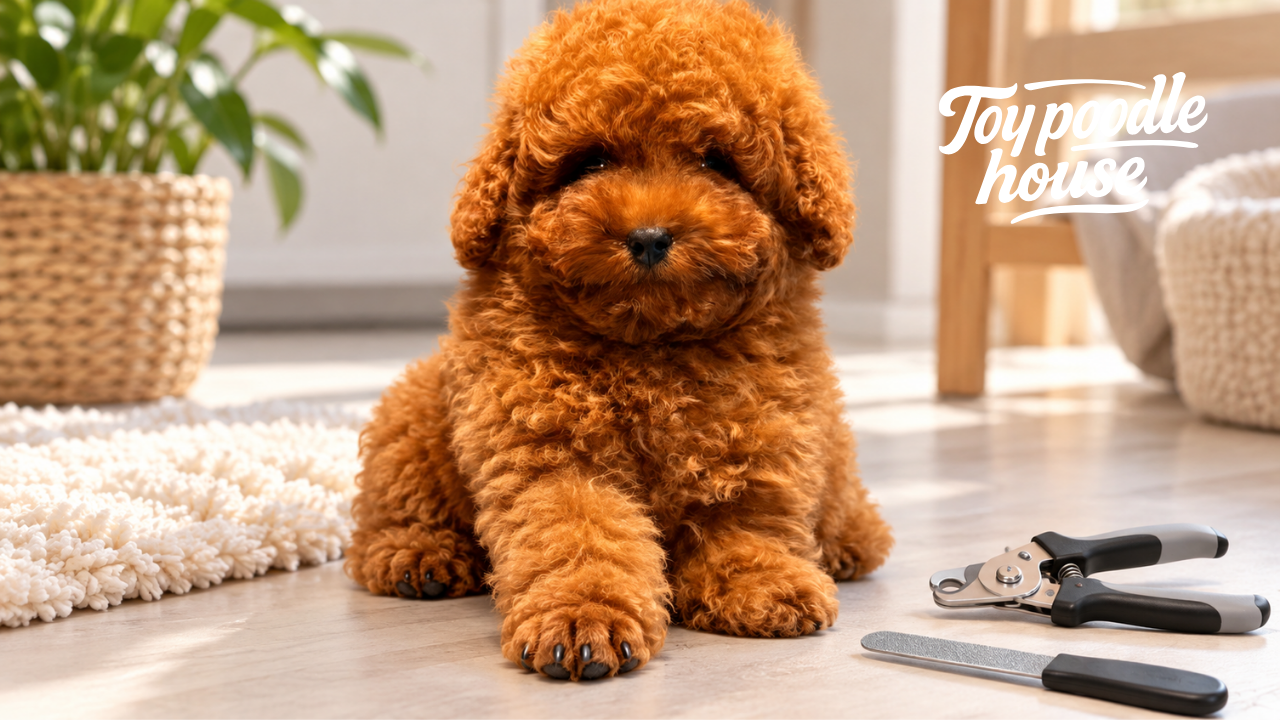
The simplest way to tell whether nails are too long is this: properly trimmed nails do not touch the floor. If the nails make contact when your dog stands square, or you hear clicking on hard floors, it is time for a trim. Small breeds generally need this every three to four weeks. And for a Toy Poodle there is a further consideration: long nails and the hair between the pads both reduce grip on slippery floors.
Nail trimming is the grooming task most owners put off.
The reason is understandable — fear of cutting the quick.
But that postponement makes the very problem it fears worse, and the reason is explained further down.
Two simple tests first
Before technique, the question of whether it is needed at all.
The rule in published guidance is clear: when nails are trimmed appropriately, they should not touch the floor.
1. The looking test
Stand your dog square on a flat floor and look straight down at the paws.
- Nails touching the floor → too long
- Toes being pushed upward → too long
- Nails beginning to curl → overdue
- Seen in profile, the nail extends past the pad → too long
Sources also note that the pads should sit flat with weight distributed evenly across all four feet, not shifted backward.
2. The listening test
Even easier.
Walk your dog across tile, laminate or hardwood and listen.
- Soft taps → nails are fine
- A steady clicking sound → time to trim
This requires no equipment and can be done daily.
Why this matters more for a Toy Poodle
Long nails have two consequences, and the second is the critical one for this breed.
1. Stance and gait change
The wording in published sources is direct: when nails get long enough to touch the floor, they change the way a dog stands and walks.
And it continues: veterinary sources note that overlong nails alter a dog’s gait and posture, which over time can lead to pain and inflammation in the joints.
2. Grip on slippery floors is lost
And this is the point that matters most here.
From the same source: long nails rob a dog of traction on slick surfaces like hardwood and tile.
Consider why that matters for a Toy Poodle specifically. This breed:
- Lives predominantly indoors
- Moves mostly across hard, smooth flooring
- And has a recognised predisposition to patellar luxation
A foot slipping on a smooth floor loads the knee suddenly and without control. In a joint already predisposed, that is an unwelcome mechanical stress.
So in this breed, nail care is not a cosmetic matter — it is a preventive one.
And indoor life removes natural wear
Dogs that walk a lot on pavement wear their nails down naturally.
But as sources note, indoor dogs living on carpet and hardwood get almost none of that benefit — so their nails need checking more often.
The Toy Poodle fits that description exactly.
How often?
| Situation | Suggested interval |
|---|---|
| Small breeds (general) | Every 3-4 weeks |
| Predominantly indoors | May need checking more often |
| Walks a lot on hard surfaces | May go longer |
But there is a better measure than the calendar: the two tests above. Do the listening test weekly.
Where is the quick?
Inside the nail is living tissue containing blood vessel and nerve. That is the part not to cut.
Light-coloured nails
Relatively easy. The quick appears as a pink triangle visible from the side or top of the nail.
The target: cut approximately 2-3 mm away from the quick.
Dark nails
Here is the difficulty — the quick is not visible from outside. Three techniques are described.
1. The groove on the underside
Turn the paw over and look at the underside of the nail. Sources describe a small triangular hollow groove marking the boundary between hard keratin and the softer vascular tissue.
2. The “pre-quick” dot — the most important stop signal
This is the single most useful thing to know about trimming dark nails.
As you take small slivers off, watch for a small black or pink dot appearing on the cut surface of the nail.
The warning is direct: when you see this black dot, stop trimming or you may go too far.
That dot is the area just before the quick. The nail is telling you to stop.
3. Backlighting
Holding a torch a few inches behind the paw can reveal shadow differences in dark nails.
The governing rule: little and often
One source puts it perfectly: two or three tiny slivers off a dark nail are far safer than one confident chop.
An important truth about neglected nails
This is decisive for anyone who has been putting it off.
As sources note: in some dogs, especially those who have not received regular nail trims, the quick may be grown out almost to the end of the nail.
The quick grows along with the nail.
Two consequences follow
1. It cannot be fixed in one session. Cutting an overgrown nail back to the correct length in one go means cutting the quick.
2. The solution is frequent, small trims. Taking a little each time allows the quick to recede over weeks.
This is precisely the cost of delay: the longer you wait, the longer it takes to get back to normal.
Step by step
- Set up. Good light, a calm space, sharp clippers of the right size.
- Settle your dog. In your lap or against your body, steadying one paw gently.
- Expose the nail. Part or trim the hair covering it.
- Light nails: cut approximately 2-3 mm beyond the pink quick.
- Dark nails: take just the tip first, then small slivers, checking the cut surface each time.
- Stop at the dot.
- Aim for the point where the nail begins to curve — but stop sooner if you reach the quick.
- Don’t forget the dewclaws.
- Finish positively. Treat and praise.
It doesn’t have to be all four paws in one session
With puppies and anxious dogs, two paws in a day is fine. A session forced through makes the next one much harder.
If you cut the quick
- Stay calm. Your reaction shapes your dog’s.
- Apply pressure with a clean cloth.
- Keep a clotting product to hand. Ask your vet which is suitable and have it ready before you start.
- If bleeding does not stop or recurs, contact your vet.
One note: a dog remembers this. Patience and rewards matter even more in subsequent sessions.
Dewclaws: the most forgotten
The small nail on the inner side of the front paws, sitting slightly higher up.
The warning is important: dewclaws do not contact the ground, so they often become overgrown and can even curve around until they grow into the paw pad.
Check them at every trim.
Hair between the pads
This matters particularly in a breed whose coat grows continuously.
It causes two separate problems
1. It hides the nails. As sources note, in very furry breeds you may need to part or trim the hair on the paw in order to see the individual nails.
2. It reduces grip. Hair protruding between the pads prevents them contacting the floor — which on slippery surfaces means a direct slip risk.
That second point runs on the same mechanism as the nail issue above, and the two combine.
What to do
Published guidance is clear: it is imperative to trim the hair between the pads, as well as any excess hair growing around the edges of the paw.
- Trim hair between the pads level with the pads
- Tidy excess hair around the paw edge
- Blunt-ended scissors are safer
- Stop if your dog moves
A practical tip for furry paws
If you use a rotary grinder, long hair catching in the tool is a genuine problem.
The recommended solution: push the dog’s nails through a cheap pair of pantyhose before grinding. The nails come through; the hair stays contained.
Additional measures for slippery floors
- Non-slip rugs or runners along routes your dog uses frequently
- Floor grip at the points where they get on and off furniture
- Limiting jumps from height
- Traction aids for the paws, considered with your vet
In small breeds, jumping off a sofa means landing on a slippery floor — one of the more demanding movements for the knee.
Starting young
- Handling first. For several days, hold the paws gently and reward, with no clipper in sight.
- Then the tool. Let them sniff it and hear it, paired with treats.
- Start with one nail. One nail in the first session is a success.
- Always end positively.
- Repeat regularly, even when no trim is needed.
A dog accustomed early to having its paws handled accepts this for life. The reverse is equally true.
When to get professional help
- Nails very overgrown or curling
- Your dog reacts strongly to paw handling
- You are not confident with dark nails
- A dewclaw has grown into the pad
- Redness, swelling or excessive licking of the paw
The last is a separate category and needs veterinary assessment.
In summary
Two tests tell you whether nails are too long: contact with the floor when standing square, or clicking on hard floors. The rule is that properly trimmed nails do not touch the floor.
Small breeds generally need trimming every three to four weeks, and indoor dogs more often because they get almost no natural wear.
For a Toy Poodle there is an extra dimension: long nails alter stance and gait and reduce grip on slippery surfaces, and hair between the pads does the same. In a breed predisposed to patellar luxation, slipping is a mechanical risk — which makes nail and paw care preventive rather than cosmetic.
In dark nails, the most important stop signal is the small dark dot appearing on the cut surface.
And the cost of delay is concrete: in dogs not regularly trimmed, the quick grows out with the nail, sometimes almost to the tip. Returning to normal then takes weeks of frequent, small trims.
To learn about our health-screened Toy Poodle puppies, accustomed to paw handling from early on, you can reach us on WhatsApp or read about our standards on the certificates page.
Frequently Asked Questions
How do I know if the nails are too long?
Two tests. Stand your dog square and look down: if the nails touch the floor, they are too long. Or walk them on a hard floor and listen: a steady clicking sound means it’s time. Properly trimmed nails do not touch the floor.
How often should they be trimmed?
Small breeds generally every three to four weeks. Indoor dogs on carpet and hardwood get almost no natural wear, so they need checking more often. The weekly listening test is more reliable than the calendar.
How do I find the quick in dark nails?
Three methods: the triangular groove on the underside, backlighting with a torch, and most importantly watching for the dark dot on the cut surface. When that dot appears, stop.
Are long nails really harmful?
Yes. Sources note that nails long enough to touch the floor change stance and gait, which over time can cause joint pain and inflammation. They also reduce traction on slick surfaces like hardwood and tile.
Why trim the hair between the pads?
It hides the nails, making trimming harder, and prevents the pads contacting the floor, reducing grip on slippery surfaces. Guidance states trimming it is imperative.
Can I shorten very overgrown nails in one go?
No. In dogs not regularly trimmed, the quick may have grown almost to the end of the nail. The solution is frequent small trims; the quick recedes over weeks.
Do dewclaws need trimming too?
Yes, and they are the most forgotten. Because they do not contact the ground they often become overgrown and can curve around until they grow into the paw pad.
I cut the quick — what should I do?
Stay calm and apply pressure with a clean cloth. Having a clotting product ready before you start is useful; ask your vet which is suitable. If bleeding does not stop or recurs, contact your vet.