There are three priority areas Toy Poodle owners can monitor at home: the kneecap, the ears and the teeth. The most characteristic sign of patellar luxation is a “skipping” gait that resolves on its own after a few steps. Ear problems arise from two breed-specific risks combining: drop ears and hair growing inside the ear canal. Dental disease begins early in this breed because of the small jaw.
You bought your puppy from a breeder who health-screens. Genetic testing was done, the paperwork is in your hands.
So what comes next?
Breeder testing reduces inherited risk. But whether the dog stays healthy across a fifteen-year life depends largely on what the owner notices — and how early they act.
This article covers the three priority areas you can monitor at home. Genetic screening protocols on the breeder’s side are covered in a separate article.
1. Patellar luxation (kneecap dislocation)
The patella is a small bone in the knee, sitting within a tendon and moving in a groove at the end of the thigh bone.
If that groove is too shallow or the supporting structures are weak, the patella can slip out of place during movement.
Cornell University College of Veterinary Medicine notes this condition is more common in small breed dogs and names the Toy Poodle directly among them.
The characteristic sign: a “skipping” gait
This is the clearest signal an owner can spot at home — and the description is precise.
According to Cornell, the most commonly seen sign is a “skipping” gait, which looks like a sudden three-legged hindlimb lameness that quickly resolves after a few steps.
In practice: the dog is walking or running, suddenly lifts a hind leg, moves a few paces on three legs, then returns to normal — as though nothing happened.
Which is exactly why it gets missed. It is brief, self-resolving, and the dog does not appear to be in pain.
Other signs to watch for
- Intermittent limping
- Sudden pausing while running
- Reluctance to jump
- Stretching a hind leg backwards
- Hesitation on stairs or before jumping onto furniture
- Sitting with the leg held out to the side
How is it diagnosed?
Diagnosis rests on physical examination. The vet palpates the knee, attempting to push the patella out of its groove, and grades it according to how easily it displaces and whether it stays out.
X-rays may follow to assess the depth of the groove, check for arthritis and evaluate hip conformation.
The practical takeaway: ask for an orthopaedic assessment at the annual check-up. Physical examination is the cornerstone of diagnosis and belongs in routine care.
Treatment
Mild cases are generally managed with monitoring and lifestyle adjustment: weight control, joint supplements, anti-inflammatory medication where needed, and physiotherapy.
Severe or painful cases may require surgical correction to prevent long-term joint damage.
One further point: in higher grades, cranial cruciate ligament disease occurs more frequently as a secondary problem. So a knee issue caught early matters not only in itself but for what it may prevent later.
What you can do at home
- Weight control. Excess weight directly increases load on the knee.
- Limit jumping down. Use a ramp or steps rather than letting them jump off sofas and beds.
- Watch slippery floors. Sudden turns on hard flooring create risk; rugs and non-slip mats help.
- Keep hair between the paw pads short. Long hair increases slipping.
- Trim nails regularly. Overlong nails alter posture.
- Regular, measured exercise. Muscle supports the joint, but avoid strenuous activity.
2. Ear health
This is the most frequent and most recurrent problem Toy Poodle owners encounter.
That is not coincidental — two breed-specific anatomical factors combine.
Two risk factors together
1. Drop ears. The Poodle’s long, pendulous ears cover the ear canal.
2. Hair growing inside the ear canal. This is a breed-specific feature and one many owners are unaware of.
The literature attributes the high incidence and chronicity of otitis externa in Poodles to precisely these two factors.
The mechanism: why the environment deteriorates
Together they produce a specific result: abnormally reduced airflow within the ear canal, greater humidity and reduced acidity.
The resulting environment favours microbial growth. Poodles are especially prone to Malassezia overgrowth in the ear canals.
Among bacterial infections, those caused by Pseudomonas species are the most serious — both in the pain they cause and the difficulty of treatment.
Allergic skin disease is also considered important in Poodles. So recurrent ear infection is sometimes not solely an ear problem.
The critical point: a self-perpetuating cycle
Read this section carefully, because it explains why “let’s wait and see” is a poor approach.
Inflammation in the ear canal leads to thickening of the canal wall — from scarring, sometimes calcification, and thickening of the outer skin layer. The skin glands enlarge and their secretions increase.
The result: the canal narrows further. A narrower canal means less airflow and more humidity — strengthening the very environment that sustains the inflammation.
So every untreated infection makes the next one easier.
In advanced cases treatment becomes difficult, and the literature notes that severe cases may require major surgery to remove the outer wall of the ear canal or the canal entirely.
Warning signs
- Scratching the ear or rubbing it along the floor
- Head shaking or holding the head tilted
- Odour from the ear
- Redness or swelling inside the ear
- Dark or increased discharge
- Reacting to the ear being touched
- Restlessness, disturbed sleep
Odour is usually the first thing noticed and should not be normalised.
What you can do at home
- Check regularly. Lifting the ears and looking inside weekly should become habit.
- Dry after bathing. The ear area must be dried thoroughly; moisture is the key trigger.
- Use the cleaner your vet recommends. Product and frequency should be determined by your vet.
- Never put cotton buds into the ear canal. They push debris inward and can cause damage.
- Discuss canal hair with your vet. Approaches vary between individual dogs; treat it as something to assess rather than a routine assumption.
- Investigate the underlying cause of recurrent infections. Assessment for allergy may be warranted.
Point five matters. Removing hair from the ear canal is a common practice but may not be appropriate for every dog or every situation. The decision belongs with your vet.
3. Dental health
The literature puts it plainly: preventive dental care is non-negotiable for this breed.
Dental disease is among the most common conditions in dogs and is particularly prevalent in small breeds, including the Toy Poodle.
Why more common in this breed?
The reason is anatomical. The jaw is small but the number of teeth is the same as in large breeds. Teeth sit crowded, food accumulates between them and plaque forms faster.
Plaque hardens into tartar; tartar leads to gum inflammation, then gum recession and tooth loss.
And the effects are not confined to the mouth — in small breeds, advanced dental disease is reported to contribute to organ damage.
Warning signs
- Persistent bad breath
- Red or bleeding gums
- Yellow-brown deposits on the teeth
- Difficulty eating, or chewing on one side
- Reacting to the mouth being touched
- Excessive drooling
- Loose or lost teeth
Bad breath should not be normalised as “dog smell.” Persistent odour is usually the first sign of a problem.
What you can do at home
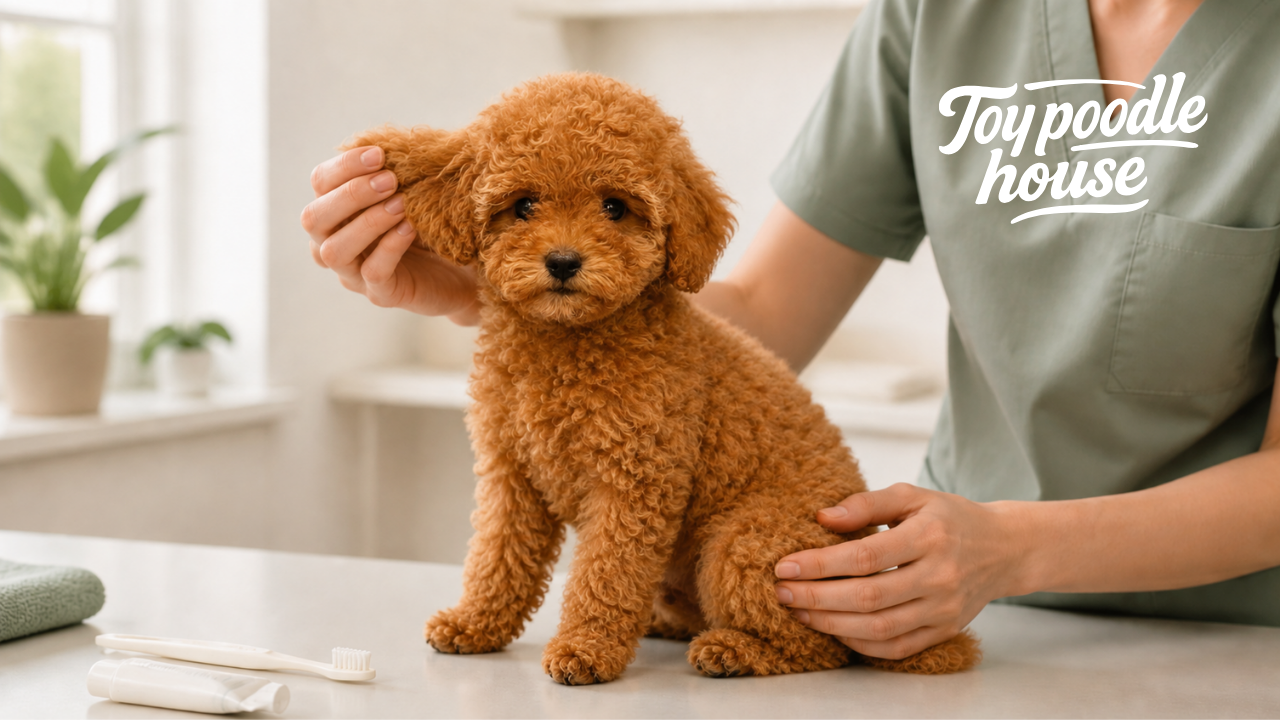
- Regular brushing. Daily is ideal; even a few times weekly makes a clear difference.
- Dog-specific toothpaste. Human toothpaste is not suitable.
- Start young. Dogs introduced early accept it without difficulty.
- Dental support products. These complement brushing, they do not replace it.
- Annual oral examination as part of routine care.
- Watch for retained baby teeth. In small breeds milk teeth sometimes fail to fall out, disrupting alignment — check particularly around 6 to 8 months.
- Professional cleaning. Necessity and frequency determined by your vet.
Monitoring by age
| Period | Priorities |
|---|---|
| 0-1 year | Vaccination programme, parasite treatment, milk teeth check, introducing tooth brushing, establishing the ear-check habit |
| 1-7 years | Annual examination, orthopaedic assessment, oral examination, weight monitoring, ear checks |
| 7 years and over | Twice-yearly checks, blood work, joint assessment, eye examination, dental status |
The “orthopaedic assessment” in the middle row matters particularly. It can be skipped in a routine examination unless specifically requested.
When to see a vet
- Recurrent skipping gait or limping
- Odour or significant discharge from the ear
- Constant head shaking or head tilt
- Persistent bad breath
- Difficulty eating
- Sudden reaction to the ear or mouth being touched
- Unexplained reduction in activity
None of these should be watched in the hope they resolve on their own. On the ear side in particular, every delay makes the next episode harder to manage.
In summary
The three priority areas for a Toy Poodle owner are the knees, the ears and the teeth.
The characteristic sign of patellar luxation is a skipping gait that resolves on its own — which is precisely why it gets missed. Ask for orthopaedic assessment at the annual check-up.
Ear problems arise from two breed-specific factors combining: drop ears and hair inside the ear canal, which together reduce airflow and raise humidity. The critical point is that inflammation narrows the canal and thereby sustains itself — which is why early action is decisive.
On dental health, the small jaw and crowded teeth make preventive care non-negotiable in this breed.
What these three share: none requires expensive or complicated intervention. All are a matter of regular observation and habit.
To learn about our health-screened Toy Poodle puppies, you can reach us on WhatsApp or read about our process on the certificates page.
Frequently Asked Questions
How do I recognise patellar luxation?
The most characteristic sign is a “skipping” gait — a sudden three-legged hindlimb lameness that resolves quickly after a few steps. Because it is brief and self-resolving, it is frequently missed.
Is patellar luxation common in Toy Poodles?
Cornell University College of Veterinary Medicine notes it is more common in small breeds and names the Toy Poodle directly. Genetics play a significant role; it can also follow trauma.
Does patellar luxation require surgery?
It depends on severity. Mild cases may be managed with monitoring, weight control and joint support. Severe or painful cases may require surgical correction to prevent long-term joint damage.
Why do Poodles get ear infections so often?
Two anatomical factors combine: drop ears and hair growing inside the ear canal. Together these reduce airflow, raise humidity and lower acidity, creating an environment favourable to microbial growth.
Is it harmful to wait out an ear infection?
Yes. Inflammation thickens the canal wall, narrowing the canal and strengthening the environment that sustains the inflammation. Every untreated infection makes the next one easier. Advanced cases may require surgery.
Should hair be removed from the ear canal?
Approaches vary between individual dogs and this should not be assumed as routine. Discuss with your vet whether it is appropriate for your own dog.
Why is dental care so important in this breed?
The jaw is small but the number of teeth is the same as in large breeds. Crowded teeth trap food and accelerate plaque formation. The literature describes preventive dental care as non-negotiable for this breed.
Which signs need prompt veterinary attention?
Recurrent skipping gait, ear odour or discharge, constant head shaking, persistent bad breath, difficulty eating, and sudden reaction to the ear or mouth being touched.