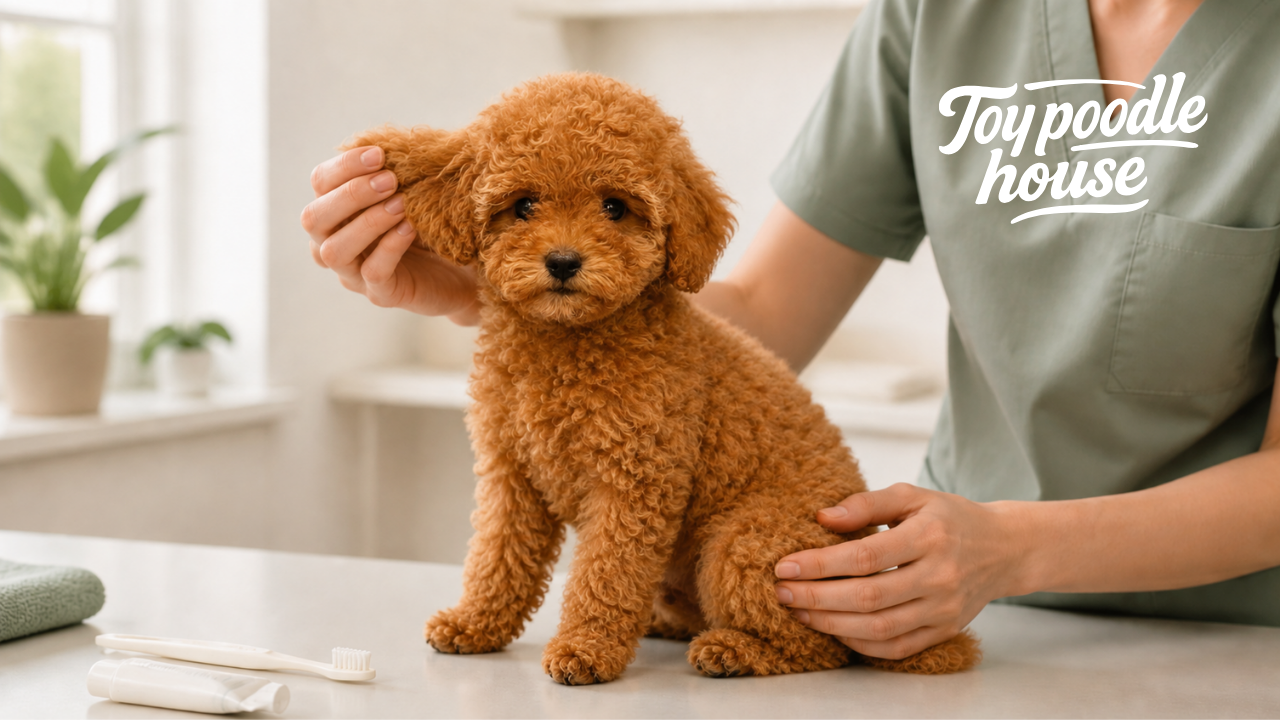
Low blood sugar in Toy Poodle puppies is a genuine emergency that can turn fatal within hours. Lethargy, staggering, trembling and pale gums are the first signs. The emergency response is to rub honey or glucose syrup onto the gums while warming the puppy at the same time. This is not treatment — it buys time. A vet visit must follow.
You may be reading this during an emergency. So we start with the protocol.
🔴 EMERGENCY RESPONSE
If the puppy is conscious and able to swallow
- Put a small amount of honey or glucose syrup on your finger.
- Rub it onto the gums and the inside of the cheek. Sugar is absorbed through the oral mucosa — swallowing isn’t required.
- Don’t give too much, and keep it away from the back of the throat.
- Warm the puppy at the same time. Blanket, your lap, a warm room. Not a hot water bottle or heater directly against the body.
- Go to a vet immediately — even if the puppy recovers.
⚠️ If the puppy is unconscious, seizing, or unable to swallow
Put nothing in its mouth.
Liquid can enter the airway, and that can kill faster than the hypoglycaemia itself.
The only thing to do: keep the puppy warm and get it to a vet as fast as possible.
Why “it recovered” isn’t enough
Honey raises blood sugar temporarily. But it:
- Does not resolve the underlying cause
- Wears off, and the episode can return
- May be masking a separate problem — infection, parasites or a liver shunt
Veterinary treatment involves intravenous dextrose, restoring normal body temperature, fluid support and investigation of the cause.
Hypoglycaemia in a puppy is always an emergency.
What is hypoglycaemia?
It is a fall in blood glucose below the normal range.
In dogs it is defined as below 60 mg/dL (3.3 mmol/L). Signs typically appear once levels drop under 40–50 mg/dL (2.2–2.8 mmol/L).
The brain draws its energy almost entirely from glucose and cannot store it. That is why the nervous system is affected first — hence the lethargy, staggering, trembling and seizures.
Why Toy Poodle puppies are so vulnerable
1. The reserve is small
Puppies lack the energy reserves adults have. Small breed puppies are at an even greater disadvantage: limited fat and muscle mass and an immature liver mean reduced glycogen storage.
2. Consumption is high
Small breed puppies have a higher metabolic rate and energy requirement per unit of body mass than larger puppies.
Small tank, fast burn.
3. Cold starts a vicious cycle
This is the least-known and possibly most important part.
Small puppies are also prone to hypothermia. And in a cold puppy:
- Appetite drops
- Gastrointestinal utilisation of food falls
Both lower blood sugar. And low blood sugar in turn reduces the body’s capacity to generate heat.
Cold lowers blood sugar; low blood sugar makes the puppy colder.
This is why warming matters as much as honey in an emergency — in veterinary protocols, “warming to normal body temperature” sits alongside IV dextrose as a distinct step.
Which age range?
The risk window generally runs from weaning to roughly 3–4 months.
And the good news: nearly all affected puppies outgrow it. As the body grows, storage capacity increases, the liver matures and metabolic balance settles.
The exception: genuinely very small individuals may have episodes throughout life.
That frames the risk properly — for most puppies this is a phase to get through, not a permanent condition. But during that phase, vigilance genuinely matters.
Triggers
| Trigger | Why |
|---|---|
| Missed meal | The commonest cause. The reserve is already small. |
| Poor or fussy eating | Effectively a missed meal |
| Stress | New home, travel, vet visit |
| Overplaying | Consumption spikes |
| Cold | The cycle above |
| Vaccination | Stress plus temporary loss of appetite |
| Intestinal parasites | Impair nutrient absorption |
| Liver shunt | Underlying structural problem |
| Glycogen storage disease | Rare, inherited |
The last two matter: repeated episodes may point to an underlying condition requiring investigation, not simply inadequate feeding.
Signs, in sequence
Early
- Lethargy, drowsiness — stops playing, doesn’t respond when called
- Loss of appetite
- Dullness — simply “not right”
Progressing
- Staggering, loss of balance
- Muscle tremors, twitching
- Weakness — unable to stand
- Pale or white gums
Severe
- Seizures
- Shock
- Coma
Untreated, it is fatal.
Check the gums
This is the easiest check you can make. Lift the upper lip and look at the colour.
Healthy gums are pink. Pale, greyish or whitish gums are a serious warning sign.
And there’s a useful symmetry: the gums are both what you check and where you apply the treatment.
Prevention: a practical plan
Feeding frequency
For very small puppies, the recommended approach is energy-rich, easily digestible food every 4–6 hours.
The critical threshold: going 6–8 hours without food can be life-threatening for a very small puppy.
This explains why the overnight gap matters. If the interval between the last evening meal and breakfast exceeds that, plan a night feed.
What to feed
- A complete, balanced, age-appropriate diet — there is no special “hypoglycaemia diet”
- Canned or softened food for very small puppies whose mouths can’t manage dry kibble
- If the puppy won’t eat, consult a vet rather than persisting
Keep at home
- Honey or glucose syrup — somewhere you can reach quickly
- Your vet’s number and the nearest 24-hour clinic — not just saved, but to hand
- A soft blanket
Extra care at higher-risk times
Arrival in a new home, vaccination day, travel, vet visits, cold weather and after long play sessions — shortening the feeding interval at these times is a sensible precaution.
Parasite control
Don’t neglect routine parasite control. Intestinal parasites impair nutrient absorption and set the stage.
What do “teacup” and “tiny” actually mean?
They are not recognised size classes
As veterinarian Dr. Catherine Barnette notes, teacup dogs are not a separate breed, and the term is purely subjective with no specific definition.
So “teacup” in a listing gives you no verifiable information about the dog’s size.
How are they produced?
- Selecting the smallest puppy from each litter and breeding those together
- Some breeders restricting nutrition to stunt growth
The second point is directly relevant here: a nutritionally restricted puppy starts with even less of an already inadequate energy reserve.
Reported health problems
| Problem | Note |
|---|---|
| Hypoglycaemia | The commonest issue in young puppies |
| Liver shunt | Stunted growth, neurological signs, seizures |
| Hydrocephalus | Fluid on the brain |
| Heart disease | — |
| Bone fractures | Fine bones increase susceptibility |
| Digestive disorders | — |
The practical conclusion
The word tells you nothing about the dog — but it tells you something about the seller.
What to ask isn’t size. It’s whether the parents have been health-tested, at what age puppies are released, whether vaccinations and worming are done, and whether you can visit in person.
Age at release
Some breed associations hold that puppies should not be released before 12 weeks, with the smallest sometimes kept until four months.
The reason is precisely the subject of this article: to let the narrowest part of the risk window pass first.
In summary
In an emergency: rub honey or glucose syrup onto the gums, warm the puppy at the same time, go to a vet immediately. If the puppy is unconscious or seizing, put nothing in its mouth — keep it warm and get to the clinic.
The mechanism: small reserve, high consumption, and a vicious cycle driven by cold. That is why warming is not a secondary comfort measure but half the response.
Prevention: feeding every 4–6 hours, avoiding 6–8 hour gaps, extra care during stress and cold, and routine parasite control.
And the frame: the risk window runs from weaning to 3–4 months, and nearly all affected puppies outgrow it. Vigilance during that period is a few months of discipline, not a lifelong worry.
If your puppy has repeated episodes, the cause may lie beyond the feeding routine and should be investigated by a vet.
Frequently Asked Questions
What are the signs of hypoglycaemia in a Toy Poodle puppy?
Early on: lethargy, drowsiness, loss of appetite and dullness. As it progresses: staggering, muscle tremors, weakness and pale or white gums. Severely: seizures, shock and coma. Untreated, it is fatal.
How much honey should I give in an emergency?
A small amount on your finger, rubbed onto the gums and inside of the cheek, is enough — sugar is absorbed through the oral mucosa. Don’t give too much and keep it away from the back of the throat, as there is a risk of aspiration. Ask your vet for guidance specific to your puppy.
My puppy collapsed — can I still rub honey on its gums?
No. Nothing should be put in the mouth of a puppy that is unconscious, unable to swallow or seizing, as liquid can enter the airway. Keep it warm and get to a vet as fast as possible.
The honey worked and my puppy recovered. Do I still need the vet?
Yes. Honey raises blood sugar temporarily but doesn’t resolve the cause, and the episode can return. Hypoglycaemia in a puppy is always treated as an emergency.
Why does warming matter too?
A cold puppy eats less and digests less efficiently, which lowers blood sugar — and low blood sugar reduces heat production. The two feed each other. In veterinary protocols, restoring normal body temperature sits alongside IV dextrose as a core step.
How often should I feed my puppy?
For very small puppies, energy-rich and easily digestible food every 4–6 hours is the recommended approach. Going 6–8 hours without food can be life-threatening, so if the overnight gap exceeds that, plan a night feed.
When does the risk pass?
The window generally runs from weaning to around 3–4 months, and nearly all affected puppies outgrow it. Genuinely very small individuals may have episodes throughout life.
Is “teacup Toy Poodle” a real size?
No. Veterinary sources state that teacup is neither a separate breed nor a defined size class; the term is purely subjective and gives no verifiable information about the dog.
Why is the risk higher in very small puppies?
Limited fat and muscle mass and an immature liver mean a small glycogen reserve, while energy requirement per unit of body mass is high. Some breeders have also been reported to restrict nutrition to stunt growth, which reduces an already inadequate reserve further.
This content is for information only and does not replace veterinary examination. If you see signs of hypoglycaemia in your puppy, apply the first-aid steps above and contact a veterinarian without delay.