A Toy Poodle’s coat grows continuously, and shed hair does not fall away — it catches in the curls. Without regular brushing, matting is inevitable. Brushing frequency depends on clip length: every few days for short cuts, daily for longer coats. Professional grooming intervals generally fall between 4 and 8 weeks depending on the style chosen.
The most common frustration among Toy Poodle owners follows a familiar pattern: everything seems fine, and then one morning the comb won’t go through.
It usually starts behind the ears. Then the armpits, the inner thighs, the base of the tail. And by the time it’s noticed, the problem has already taken hold.
This rarely comes from neglect. It comes from not understanding how the coat actually works. Poodle hair behaves differently from other breeds, and the care routine has to reflect that.
This article covers why the coat mats, the popular clip styles, a realistic care routine, and the stage most owners are never warned about.
Why is Poodle coat different?
Two characteristics determine everything.
First: the coat grows continuously. In most breeds, hair reaches a set length and stops. Poodles have no such limit — the coat keeps growing, much like human hair. Regular clipping is therefore not an aesthetic choice but a necessity.
Second: shed hair doesn’t fall out. Poodles shed very little, but the small amount that does shed catches in the curled structure and remains among the living hairs.
That is the real mechanism behind matting: shed hair can’t escape, tangles with living hair, tightens over time and eventually adheres to the skin.
So the fact that Poodles “don’t shed” is not a low-maintenance feature. It means you have to remove the shed hair yourself. That is precisely what brushing does.
Why matting is a serious problem
Matting is often treated as a cosmetic issue. It isn’t.
A tightening mat pulls constantly on the skin — a persistent source of discomfort, particularly during movement. The skin beneath a mat also gets no air, and moisture becomes trapped, creating favourable conditions for bacteria and yeast.
In advanced matting, redness, sores and infection can develop. The irritated skin revealed when a mat is finally removed often surprises owners.
Warning signs:
- Dullness in coat colour — usually the first indication
- The comb catching in particular areas
- The dog avoiding being touched in a specific spot
- Persistent scratching or licking of one area
- Hair that feels stuck to the skin
The honest truth about severe matting
This needs saying plainly: attempting to brush out tight mats that have adhered to the skin causes the dog significant pain.
In these cases the most humane solution is usually a short clip. The wish to keep the coat is understandable, but hours of painful de-matting is a far worse experience for the dog.
Starting a proper routine after the clip prevents the regrowing coat from reaching the same state. A short clip is not a failure — it is a fresh start.
Popular clip styles
| Style | How it looks | Maintenance |
|---|---|---|
| Teddy Bear | Face left round and full, body kept short | Moderate to high; the face needs regular attention |
| Puppy Cut | Even, medium-short length all over | Low; the most practical option |
| Lamb Cut | Body short, more coat left on the legs | Moderate; leg hair needs regular brushing |
| Sporting Cut | Neat, practical length throughout | Low; suits active dogs |
| Short / summer clip | Very short with clippers | Lowest; preferred in warm months |
What is a Teddy Bear cut?
This has become the most requested style. It takes its name from the look: the face is left round and full like a plush toy, with the ears and cheeks supporting that roundness. The body is kept short and neat.
The result gives the dog a younger, softer expression, softening the Poodle’s naturally long muzzle.
A realistic note is needed here, though: the Teddy Bear cut is not a low-maintenance style. The longer facial hair is in constant contact with food and water, so it requires regular cleaning and combing. Hair around the eyes also needs attention, or it can cause irritation.
Owners genuinely wanting easy upkeep are better served by a Puppy Cut or Sporting Cut.
Choosing a style
- How much time can you give daily? Longer coat means daily brushing.
- Season. Shorter clips are more comfortable in summer.
- Activity level. A dog running in a garden collects debris in a long coat.
- Individual coat texture. Some Poodles have denser coats that mat faster.
- Grooming interval. If you can’t attend regularly, longer styles will cause problems.
The daily routine
“Brush daily” is common advice. It’s correct but incomplete — the frequency needed depends on clip length.
| Coat length | Brushing frequency |
|---|---|
| Very short (clipper cut) | 2-3 times weekly |
| Medium (Puppy, Sporting) | Every other day |
| Long (Teddy Bear face, Lamb legs) | Daily |
| Coat change period | Daily, regardless of length |
How to brush properly
The most common mistake is brushing only the surface. The comb glides over the top, everything looks fine — but mats form close to the skin, where nothing has been touched.
- Work in layers. Lift the coat with one hand, brush the section underneath, then move up.
- Reach the skin. If the comb isn’t reaching skin level, matting isn’t being prevented.
- Prioritise high-risk areas: behind the ears, armpits, inner thighs, neck, base of tail, between the paw pads.
- Use a slicker brush first, then a metal comb. If the comb passes through without catching, that area is clear.
- Keep sessions short and frequent. A few minutes daily beats one long session weekly.
The fifth point matters particularly. Long, difficult sessions build resistance to grooming; short positive ones build habit.
Bathing
Recommendations vary, with the general range falling between monthly and every three to four weeks. What matters is how dirty the dog actually gets.
One rule is absolute, however: never bathe a matted coat. Water tightens mats and makes them almost impossible to remove. Ensure the coat is brushed through before bathing.
Human shampoo should not be used — canine skin has a different pH. Thorough drying after bathing is also essential; a damp curly coat both mats and creates skin problems.
Professional grooming: how often?
Published recommendations range from 3 to 8 weeks. Rather than quoting one number, it’s more useful to explain what it depends on:
- Short clips allow longer intervals — 6 to 8 weeks
- Shaped styles like Teddy Bear need 4 to 6 weeks to hold their form
- Longer coats require more frequent attention
- During the coat change the interval may need shortening
Grooming visits cover more than clipping: nail trimming, hair between the paw pads, ear area care and hygiene trimming.
Choosing a groomer
Poodle grooming requires skills beyond standard dog grooming. The curled coat calls for specific techniques, and inappropriate handling can cause skin irritation or uneven results.
Useful questions: Do you work with Poodles regularly? Do you use scissors or clippers? How do you approach a matted dog? What do you do if the dog becomes stressed?
The answer to the last question is usually the most revealing.
The stage nobody warns you about: the coat change
This is the most practical section, because the majority of matting complaints arise precisely here.
Toy Poodle puppies are born with a soft, relatively manageable puppy coat. From around nine months, a process begins in which that coat transitions to the adult coat: thicker, denser and more tightly curled.
During the transition both coat types are present at once. And that is where the problem lies: the shedding puppy coat tangles into the emerging adult coat, and matting risk multiplies almost overnight.
Owners going through this are typically baffled: “I’ve been doing the same routine for months, and suddenly it’s matting.”
What to do:
- Increase brushing frequency — daily is necessary during this period regardless of length.
- Temporarily shorten the grooming interval.
- Consider a shorter clip for the duration.
- Don’t panic; once the transition completes, the routine returns to normal.
Start young: building tolerance
Coat care, like toilet training, is a habit that has to be taught.
A dog introduced to grooming as a puppy accepts brushing and grooming visits for life. Starting in adulthood is considerably harder, and some dogs develop lasting resistance.
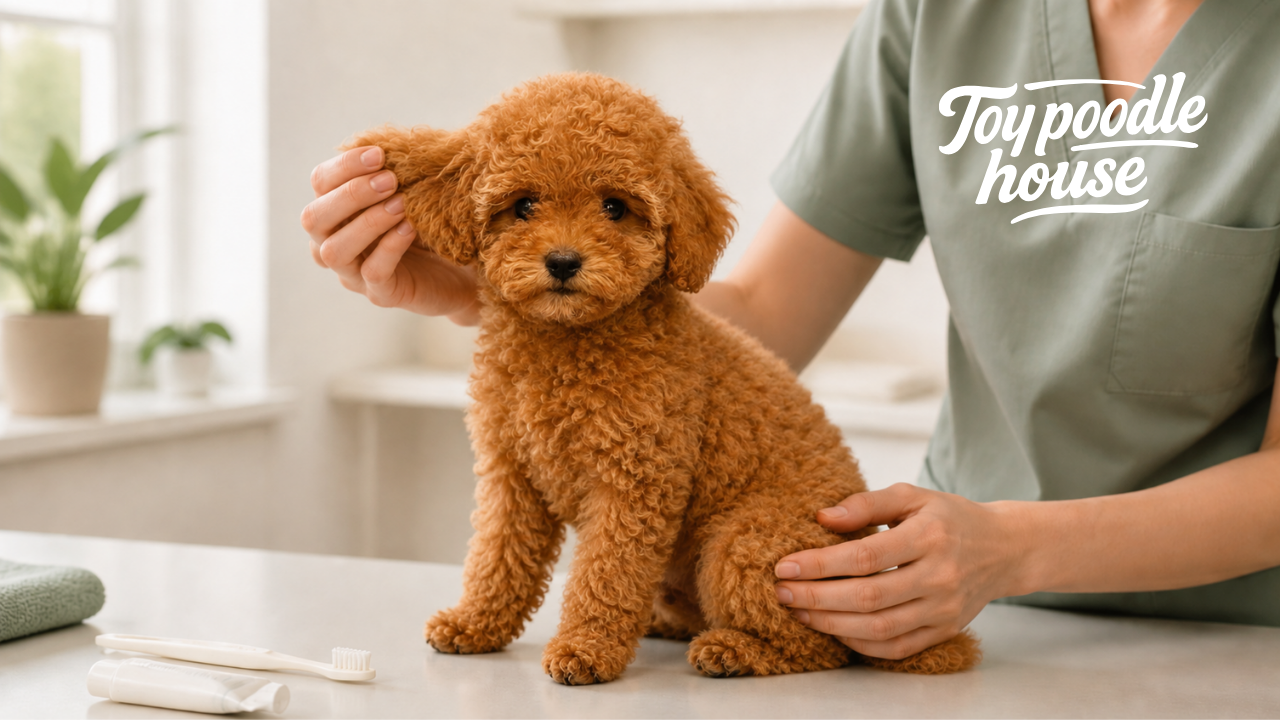
- From the first days, include touching paws, ears and the muzzle in your routine
- Introduce the brush as an object first, before using it
- Keep early sessions to one or two minutes and end with a reward
- Plan the first grooming visit early — the aim is familiarity, not the clip
- If the dog becomes tense, stop early and finish positively
The reasoning here mirrors socialisation training; you can read more about our approach.
Five common mistakes
- Brushing only the surface. Mats form near the skin; work in layers.
- Bathing a matted coat. Water tightens mats irreversibly.
- Incomplete drying. A damp curly coat mats and creates skin problems.
- Stretching the grooming interval. “Let it grow a bit longer” usually ends in mats.
- Making grooming feel like punishment. Forced sessions create lasting resistance.
In summary
Toy Poodle coat grows continuously and shed hair does not clear itself. Those two facts make regular care a requirement rather than a preference.
Brushing frequency follows the clip style: every few days for short cuts, daily for longer coats. Professional grooming generally falls between 4 and 8 weeks depending on style.
The critical period is the coat change beginning around nine months, when matting risk rises sharply and the routine needs temporary tightening.
For a Toy Poodle introduced to grooming as a puppy, all of this proceeds smoothly — and that is an investment that shapes the next fifteen years.
To learn about our Toy Poodle puppies, you can reach us on WhatsApp.
Frequently Asked Questions
Why does Toy Poodle coat mat?
Poodles shed very little, but shed hair catches in the curled structure and remains among the living hairs. Over time it tangles, tightens and adheres to the skin. Brushing exists to remove that shed hair.
What is a Teddy Bear cut?
A style in which the face is left round and full while the body is kept short, giving a plush toy appearance. It produces an endearing look but the longer facial hair requires regular cleaning and combing.
How often should I brush?
It depends on clip length. Very short cuts need 2-3 times weekly, medium lengths every other day, longer coats daily. During the coat change, daily brushing is needed regardless of length.
How often should I visit a groomer?
The general range is 4 to 8 weeks depending on style. Short clips allow longer intervals; shaped styles such as Teddy Bear need attention every 4 to 6 weeks to hold their form.
Can mats be brushed out?
Small mats caught early can be. Forcing out tight mats that have adhered to the skin causes significant pain and risks skin injury; in those cases a short clip is usually the most humane solution.
When does the coat change happen?
The transition from puppy coat to adult coat begins around nine months. Both coat types are present simultaneously, so matting risk rises sharply and the routine needs tightening.
How often should I bathe?
The general range is monthly to every three or four weeks, depending on how dirty the dog gets. A matted coat should never be bathed — water tightens mats. Complete drying afterwards is essential.
When should I start getting my puppy used to grooming?
From puppyhood. Including paws, ears and muzzle in daily handling, introducing the brush gradually and keeping sessions short is the most effective approach. Starting in adulthood is far harder.