The single most important thing to know before buying a puppy abroad is the timeline. For entry into the EU or UK from a non-listed third country such as Türkiye, the sequence of microchip, rabies vaccination, blood test and a further waiting period means a puppy is typically well past seven months old before it can legally travel. Planning around that timeline is the difference between a smooth arrival and a long delay.
Toy Poodles are among the best-suited breeds for air travel. At 2 to 4 kilograms, they fall comfortably within the cabin weight limits that exclude most dogs.
But weight is the easy part.
The harder part is the documentation sequence — and specifically, the fact that certain steps cannot be compressed no matter how well organised you are.
This guide covers what is required, in what order, and how long it takes.
Why the timeline matters more than anything else
For rabies-control purposes, countries are classified into listed and non-listed territories. Türkiye is treated as a non-listed third country for entry into the EU and UK, which triggers a stricter sequence.
That sequence cannot be reordered, and each step has a minimum interval:
- Microchip. ISO 11784/11785 standard. Must be implanted before the rabies vaccination.
- Rabies vaccination. The puppy must be at least 12 weeks old.
- Blood test (rabies antibody titration). Taken at least 30 days after vaccination.
- Waiting period. A further wait of around three months from the date the blood sample was taken.
- Animal health certificate, issued close to travel.
- Entry via a designated point of entry for travellers.
Add those minimums together: 12 weeks at vaccination, plus roughly a month before the blood test, plus roughly three months afterwards. The earliest realistic travel age is well past seven months.
This is not a formality that a good breeder can accelerate. It is a regulatory waiting period.
What this means for you
If you are choosing a puppy, the practical implication is that the dog stays in Türkiye — with the breeder — for several months after you have chosen it.
Ask specifically:
- When was the microchip implanted, and was it before vaccination?
- When was the rabies vaccination given?
- Has the blood sample been taken, and on what date?
- What is the earliest date the puppy can legally travel to my country?
A breeder who answers these with specific dates has done this before. One who says “we can arrange it quickly” has not understood the rules.
A Türkiye-specific requirement
Since 29 January 2024, for all international flights departing Türkiye — in cabin or in hold — the rabies antibody titre test document must be electronically verified by the Turkish Ministry of Agriculture and Forestry.
This is an additional administrative step beyond the test itself, and it takes time. Confirm with the breeder that it has been completed.
Documents required
| Document | Requirement |
|---|---|
| Microchip | ISO 11784/11785, implanted before vaccination |
| Rabies vaccination record | Given at 12 weeks or older, valid at travel |
| Rabies titre test | Blood taken ≥30 days after vaccination; Ministry-verified |
| Animal health certificate | Issued by a vet shortly before travel, officially endorsed |
| Vaccination record | Distemper, parvovirus, hepatitis, leptospirosis |
For the UK, dogs additionally require tapeworm treatment administered within a defined window before arrival. Verify the current requirement with the relevant authority.
Verify everything with official sources. Rules change, and the consequence of an incomplete file is refusal of entry or quarantine — not a minor inconvenience.
Cabin travel: where the Toy Poodle has an advantage
Most airlines operating from Türkiye allow cats and dogs in the cabin provided the animal and carrier together do not exceed 8 kg. Weighing is done at check-in with both together.
A Toy Poodle of 2 to 4 kg, in a carrier of 1 to 2 kg, sits comfortably below that limit. Dogs above it must travel in the hold.
There is a second advantage: some breeds are refused carriage or subject to special conditions on health or safety grounds. Poodles are not among them.
The warning nobody gives you
This is the most common avoidable problem, and it has nothing to do with paperwork.
Each flight has a limited quota for cabin pets. Holding a ticket and meeting every requirement does not guarantee your dog boards — the quota may already be full.
A pet reservation must be made separately, at least 24 hours in advance and preferably 48. Confirm it with the airline’s call centre before check-in rather than assuming.
The carrier
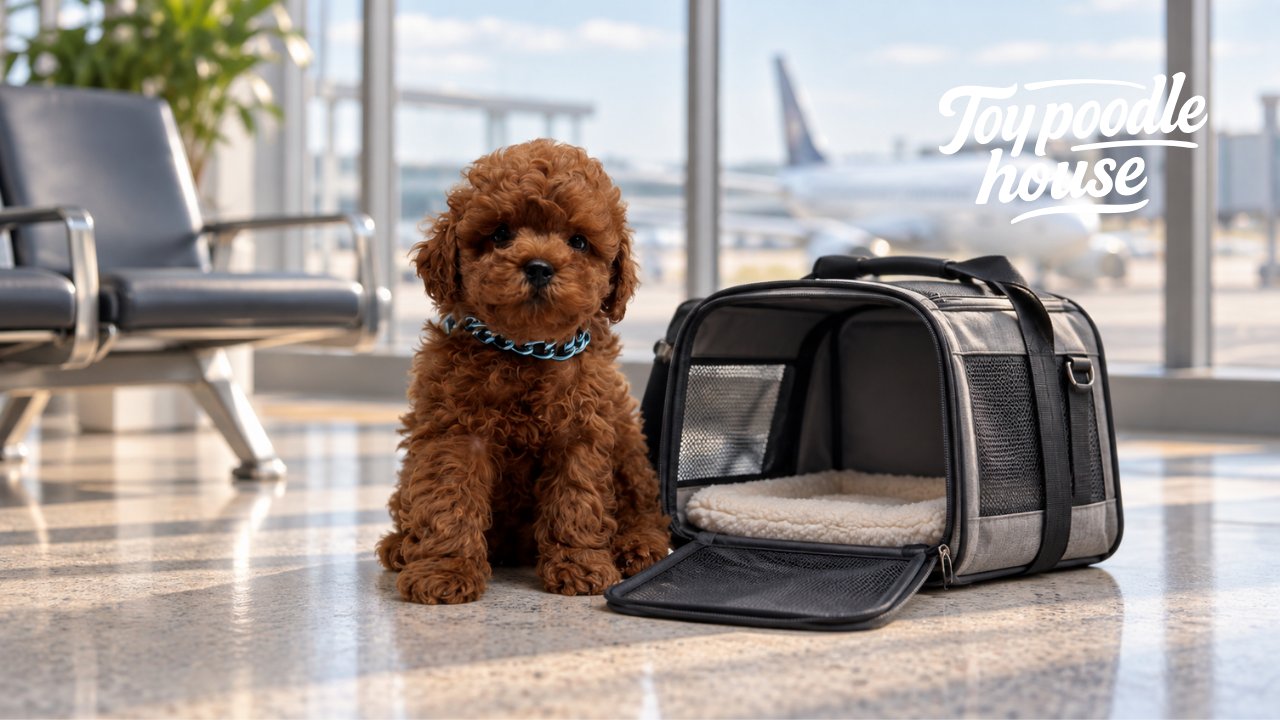
Soft carriers are generally accepted in cabin; the hold requires rigid plastic or fibreglass.
- Airline dimensions. These vary — confirm before purchasing.
- Waterproof base with an absorbent pad.
- Secure closure that cannot open in transit.
- Ventilation on multiple sides.
- Labelling with owner name, address, phone and the dog’s name.
- IATA Live Animals Regulations compliance for international flights.
The dog should be able to stand, turn around and lie down comfortably inside.
Acclimatising the carrier
This is the preparation that most determines how the journey goes, and the one most often skipped.
A dog seeing the carrier for the first time at an airport associates it with stress.
For a puppy arriving from a breeder, ask whether carrier acclimatisation has been started before departure. A well-prepared puppy travels far better, and it costs the breeder nothing but attention.
Once home, continue the process: carrier left open with treats inside, short closures, short car journeys, gradually extended.
Car travel
Restraint is a safety issue
A dog loose on a lap or seat becomes a hazard to itself and to passengers under braking.
- A carrier secured with a seatbelt
- A crate anchored in the boot or rear
- A car harness attached to a chest harness, never to a neck collar
Dogs should not travel in a front seat with an active airbag.
Motion sickness
Common in small dogs and particularly in puppies, whose balance system is still developing. It usually diminishes with age.
Early signs: excessive drooling, repeated yawning, lip licking, restlessness or whining. Noticed at this stage, a stop often prevents vomiting.
What helps:
- No food in the hours before travel; water access maintained.
- Position the dog facing forward.
- Allow a view of the horizon, but never let the head out of the window.
- Keep the car cool and ventilated.
- Stop every couple of hours on longer journeys.
- Drive smoothly; sharp acceleration and cornering trigger symptoms.
- Build tolerance with short practice trips ending somewhere pleasant.
Point seven matters most long term. A dog whose only car journeys end at the vet has already learned to dread the car.
If symptoms are severe or persist despite these measures, discuss it with your vet. Options exist, but medication and dosing are decisions for a veterinary surgeon.
Never
- Leave a dog alone in a parked car, even briefly — interior temperatures climb fast
- Transport in the boot of a saloon car
- Allow the head out of a moving window
- Carry the dog on a lap
Travel kit
- Health certificate and vaccination records, plus copies
- Pet passport where applicable
- Microchip number saved on your phone
- Collapsible bowl and water
- Familiar food, portioned
- Absorbent pads and waste bags
- Lead and harness
- A familiar toy or blanket — the smell reduces stress
- Wipes and a small towel
- Any regular medication
- A current photograph
The last item is what helps fastest if a dog is lost.
Timeline summary
| Stage | Timing |
|---|---|
| Microchip | Before vaccination |
| Rabies vaccination | From 12 weeks of age |
| Blood test | ≥30 days after vaccination |
| Waiting period | ~3 months from blood sampling |
| Health certificate | Shortly before travel |
| Pet reservation | 24-48 hours before, confirmed by phone |
| Earliest realistic travel | Well past seven months of age |
In summary
Toy Poodles travel well. At 2 to 4 kg they sit comfortably within the 8 kg cabin limit that excludes most breeds, and they are not subject to the breed restrictions applied to some dogs.
The constraint is not the dog — it is the regulatory timeline. For entry from a non-listed third country, the sequence of microchip, vaccination at 12 weeks, blood test 30 days later and a further three-month wait means the earliest realistic travel age is well past seven months.
Two things separate a smooth process from a difficult one: knowing the timeline before you choose a puppy, and making a separate pet reservation rather than assuming a ticket is enough.
To learn about our health-screened, microchipped Toy Poodle puppies and the documentation process, you can reach us on WhatsApp or read about our standards on the certificates page.
Frequently Asked Questions
How soon can a puppy travel from Türkiye to the EU or UK?
Not quickly. Türkiye is treated as a non-listed third country, requiring microchip, rabies vaccination from 12 weeks of age, a blood test at least 30 days later and a further waiting period of around three months from blood sampling. The earliest realistic travel age is well past seven months.
Can the timeline be shortened?
No. These are regulatory minimum intervals, not administrative delays. A breeder who suggests otherwise has misunderstood the requirements.
Why must the microchip come first?
The chip establishes identity, so that vaccination and test records can be linked to a specific animal. If implanted afterwards, earlier records may not be accepted.
Can a Toy Poodle travel in the cabin?
Yes. Most airlines from Türkiye allow cabin carriage where the animal and carrier together do not exceed 8 kg, weighed together at check-in. A Toy Poodle of 2 to 4 kg sits comfortably within that limit.
Does buying a ticket guarantee my dog can board?
No. Each flight has a limited quota for cabin pets and it may already be full. A pet reservation must be made separately — at least 24 hours ahead, preferably 48 — and confirmed with the airline before check-in.
What is the Ministry verification requirement?
Since 29 January 2024, for all international flights departing Türkiye, the rabies antibody titre test document must be electronically verified by the Turkish Ministry of Agriculture and Forestry. This is an additional step beyond the test itself.
What helps with motion sickness?
No food in the hours before travel, positioning the dog facing forward, a cool ventilated car, frequent stops and smooth driving. Long term, short practice journeys ending somewhere pleasant are most effective. Discuss persistent symptoms with your vet.
How should a dog travel in a car?
In a carrier secured by a seatbelt, an anchored crate, or a car harness attached to a chest harness. Never loose on a lap, and not in a front seat with an active airbag.