Toy Poodles are reported to live 14 to 18 years, with an average around 16. That is considerably longer than the 10 to 13 years typical of dogs generally. Some of what determines that figure is genetic, but a substantial part rests on decisions the owner makes every day.
Nobody asks this question while choosing a puppy. It surfaces a few months later, once the dog has settled properly into the household: “How long will we have together?”
For this breed, the answer is one of the better ones in the dog world.
The Toy Poodle is among the longest-living breeds. But this is an average, not a guarantee — and there is wide variation around it.
This article covers the actual figures, why the lifespan is so long, and the concrete levers within an owner’s control.
How long do Toy Poodles live?
| Poodle variety | Reported lifespan |
|---|---|
| Toy Poodle | 14-18 years (average ~16) |
| Miniature Poodle | 13-17 years |
| Standard Poodle | 12-15 years |
| For comparison: the average dog | 10-13 years |
The American Kennel Club gives a wider range for the Toy Poodle — 10 to 18 years. That breadth carries an important message: individual variation is considerable, and breed alone does not determine the outcome.
There are documented exceptions. A Toy Poodle named Uncle Chichi was recognised as the world’s oldest dog until 2012. A Poodle cross named Cicci died a day short of 24 years.
These are not the rule, but they show what is possible.
Why do small dogs live longer?
This is one of the more curious contradictions in canine biology. In nature, larger animals generally live longer — elephants far outlive mice. In dogs, the opposite holds.
The leading explanation concerns the metabolic burden of rapid growth. Large breeds grow far more in the same period, and this is associated with faster wear at the cellular level.
The practical implication: as a Toy Poodle owner, you start with an advantage the breed itself provides. The rest is up to you.
What determines lifespan?
| Not modifiable | Modifiable |
|---|---|
| Genetics | Body weight |
| Parents’ health history | Dental care |
| Congenital structural traits | Regular exercise |
| Sex and size | Frequency of veterinary checks |
| Nutrition | |
| Mental stimulation | |
| Home safety |
The left column is settled at the point of choosing a puppy — which is exactly why health testing of the parents matters.
The right column is the work of the next fifteen years.
Lever 1: Ideal weight
If only one thing could be chosen to extend lifespan, this would be it.
Maintaining ideal body weight throughout life is reported to reduce the risk of certain cancers, heart disease and arthritis. In small breeds, excess weight also directly increases load on the knees and spine.
The difficulty is that “ideal weight” cannot be judged by eye — particularly in a coated breed.
Body condition score: a check you can do at home
This veterinary scale assesses body composition out of 9. The target is 4 to 5.
- Ribs. With light pressure on the ribcage you should be able to feel the ribs — but not see them.
- From above. Looking down, there should be a visible waist, giving an hourglass outline.
- From the side. The abdomen should tuck upward from the ribcage rather than running level or sagging.
Doing these three checks monthly catches weight gain early. In a small dog, an unnoticed 300 to 400 grams corresponds to several kilograms in a person.
Practical points
- Set food quantity by body condition, not by the packet guideline
- Keep daily treats to a small fraction of total intake
- Avoid making table scraps a habit
- Account for the drop in energy requirement that can follow neutering
- Weigh regularly — a home scale is the simplest method
Lever 2: Dental care
The most underestimated item on this list — and its effects are not confined to the mouth.
In small breeds, advanced dental disease is reported to contribute to organ damage. It is a systemic health issue, not a cosmetic or comfort one.
Why so common in small breeds? The jaw is small but the number of teeth is the same as in large breeds. Teeth sit crowded, food accumulates between them and plaque forms faster.
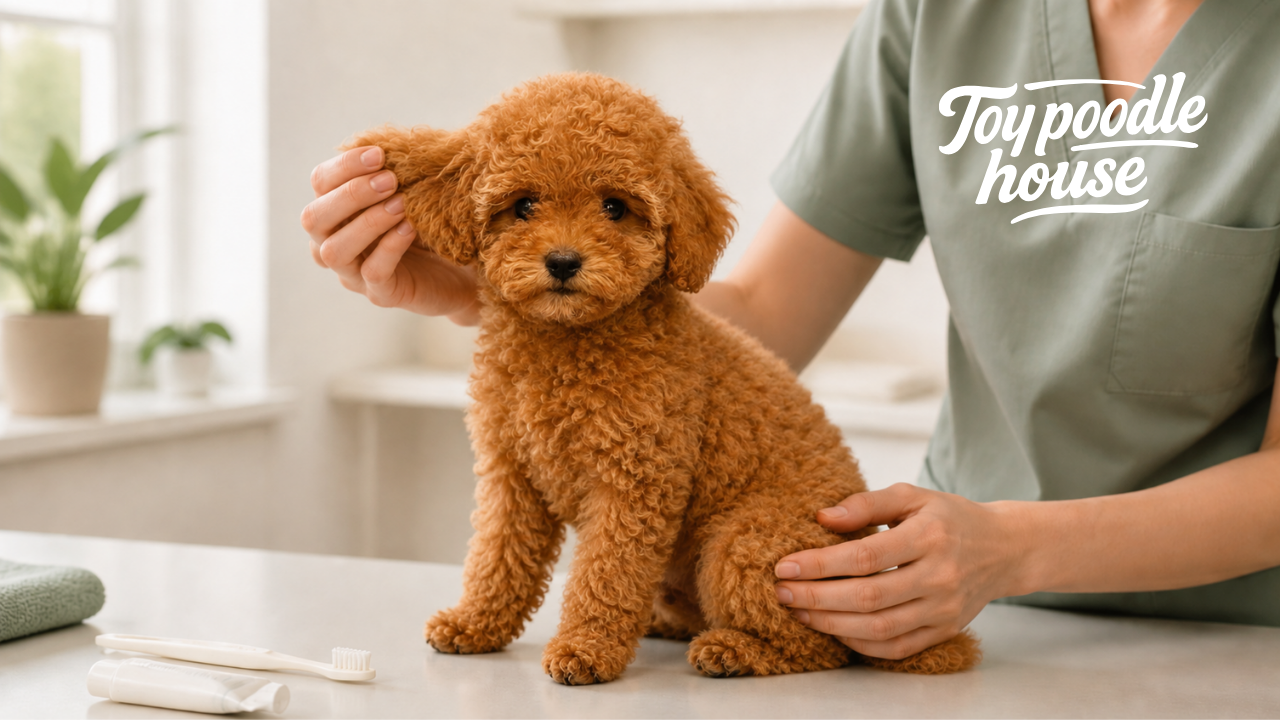
- Regular brushing. Daily is ideal; even a few times weekly makes a clear difference.
- Dog-specific toothpaste. Human toothpaste is not suitable.
- Start young. Dogs introduced early accept it without difficulty.
- Annual oral examination as part of the routine check.
- Watch for retained baby teeth. In small breeds milk teeth sometimes fail to fall out, disrupting alignment.
Bad breath should not be normalised as “dog smell.” Persistent odour is usually the first sign of a problem.
Lever 3: Regular exercise
Being small does not mean needing little movement. The Poodle was developed as a working breed, and that energy is present in smaller individuals too.
Exercise contributes to lifespan in several ways: weight control, muscle maintenance, joint health, circulation and — often overlooked — reduced behavioural problems.
- Two walks daily, with duration adjusted to age and condition.
- Indoor play. Short repeated sessions suit better than one long one.
- Avoid overexertion, particularly in puppyhood and old age.
- Watch slippery floors. The knee joint is vulnerable in small breeds; sudden turns create risk.
- Limit jumping down from sofas and beds; use a ramp or steps.
Mental exercise counts too
The Poodle sits in the top tier for working and obedience intelligence. A dog without mental stimulation becomes bored, and boredom turns into behavioural problems.
Short training sessions, scent games, puzzle toys and exposure to new environments all qualify as mental exercise.
Lever 4: Veterinary checks
The contribution here comes less from treatment than from early detection.
Dogs tend to conceal discomfort. By the time an owner notices a problem, it has often progressed. Examination closes that gap.
| Period | Recommended frequency and scope |
|---|---|
| 0-1 year | Vaccination programme, parasite treatment, development monitoring, milk teeth check |
| 1-7 years | Annual examination, boosters, dental check, weight monitoring |
| 7 years and over | Twice-yearly checks, blood work, eye examination, joint assessment |
That third row matters. Because the Toy Poodle lives long, it spends a substantial part of its life as a senior dog. Seven years is only half the breed’s average lifespan — but it is the point at which monitoring should increase.
Signs to watch in later years
- Increased water intake and urination
- Unexplained change in appetite or weight
- Reduced exercise tolerance, tiring quickly
- Coughing, particularly at night
- Difficulty with stairs or getting up
- Marked change in sleep pattern or night-time restlessness
- Disorientation, changes in established habits
Most of these get dismissed as “just age.” Some of them are signs of treatable conditions.
Lever 5: Nutrition and daily life
- Age-appropriate formulation
- Portions measured rather than estimated
- Avoidance of foods harmful to dogs
- Constant access to clean water
- Gradual transitions when changing food
Home safety is frequently overlooked. For a small dog, slippery floors, high furniture, open balconies and stairs represent genuine hazards. Accident-related injuries are common in small breeds despite being preventable.
Living long, or living well?
Lifespan is how many years a dog lives. Healthspan is how many of those years are spent free of pain, mobile and engaged.
All five levers affect both — and arguably the second more. A dog kept at ideal weight does not simply live longer; it still walks comfortably at twelve. A dog whose teeth are cared for does not simply stay healthier; it eats without pain in old age.
Sixteen years is a long time. How many of those years are genuinely good depends largely on habits established in the first ones.
To learn about our health-screened Toy Poodle puppies, you can reach us on WhatsApp or read about our process on the certificates page.
Frequently Asked Questions
How long does a Toy Poodle live on average?
Sources report a range of 14 to 18 years, with an average around 16. The American Kennel Club gives a wider range of 10 to 18 years. For comparison, the average dog lives 10 to 13 years.
Why do Toy Poodles outlive Standard Poodles?
Small breeds generally live longer than large ones. The leading explanation is the metabolic burden of rapid growth and associated faster cellular wear. Standard Poodles are reported at 12-15 years, Miniatures at 13-17 and Toys at 14-18.
How do I know if my dog is at an ideal weight?
Body condition score is used, with a target of 4 to 5 out of 9. Ribs should be palpable under light pressure but not visible, a waist should be visible from above, and the abdomen should tuck upward when viewed from the side.
Does dental care really affect lifespan?
Yes. In small breeds, advanced dental disease is reported to contribute to organ damage. Its effects are not confined to the mouth. Crowded teeth in a small jaw accelerate plaque formation in these breeds.
How much exercise does a Toy Poodle need?
Being small does not mean needing little movement. Two walks daily plus short indoor play sessions is the general approach. Sudden turns on slippery floors and jumping down from height should be avoided.
At what age is a Toy Poodle considered senior?
Seven years is the general threshold, and the point at which veterinary checks increase to twice yearly. Because Toy Poodles live long, they spend a substantial part of life in this period.
What signs should I watch for in old age?
Increased water intake, unexplained weight change, tiring quickly, night-time coughing, difficulty with stairs, changes in sleep pattern and disorientation. These should be assessed rather than dismissed as age.
What is the oldest recorded Poodle?
A Toy Poodle named Uncle Chichi was recognised as the world’s oldest dog until 2012, and a Poodle cross named Cicci died a day short of 24 years. These are exceptions rather than expectations.