Toy Poodle, Teacup and Tiny Poodle Differences: Size, Weight, Apartment Life and the Truth About Micro Poodles
One of the most confusing topics for families looking for a Poodle puppy is the difference between Toy Poodle, Teacup Poodle, Tiny Poodle and Micro Poodle. These terms are frequently used on social media, in puppy listings and by different breeders, which naturally leads people to ask: Is a Toy Poodle the same as a Teacup Poodle? What does Tiny Poodle mean? Is Micro Poodle a real breed? Which one stays smaller? And which one is more suitable for apartment life?
The main reason for this confusion is that some terms are based on recognised size classifications, while others are more commonly used as marketing or descriptive expressions. Toy Poodle is a known small-size category within the Poodle breed. Teacup, Tiny and Micro, on the other hand, are usually used to describe smaller individuals within the Toy Poodle range. However, these terms do not always refer to official or clearly defined breed standards.
That is why choosing a puppy should not be based only on the question, “Is it Toy, Teacup or Tiny?” The puppy’s true breed background, parent information, pedigree, health checks, development process and breeder reliability are just as important as its size.
A smaller dog does not always mean an easier dog. In fact, very small Poodle puppies may require more careful care in certain areas. Feeding, fall and injury risks, dental care, blood sugar balance, coat maintenance and indoor safety become especially important for these tiny companions.
In this guide, we will explain the differences between Toy Poodle, Teacup Poodle, Tiny Poodle and Micro Poodle in detail. We will cover general size ranges in centimetres and kilograms, which terms are more official, which are more flexible, which one may be more suitable for apartment life and what to consider when choosing the right puppy.
Why Is Poodle Size Classification So Confusing?
The Poodle is a breed that can be seen in different sizes. That is why when people hear the word Poodle, some imagine a large and elegant dog, while others think of a tiny, fluffy puppy that almost fits in one hand.
This is where the confusion begins. There are recognised size categories within the Poodle breed, but there are also popular terms used in everyday language and puppy listings.
For example, the Standard Poodle refers to the large Poodle size. Miniature or Mini Poodle refers to a smaller size. Toy Poodle belongs to the small Poodle group. However, terms such as Teacup, Tiny and Micro are usually used to describe a very small appearance rather than an official breed class.
The most important point is this: a dog being small does not automatically make it a Teacup or Tiny Poodle. In the same way, not every small, curly-haired puppy is a Poodle. Maltipoo, Maltese mixes and other small mixed-breed dogs may also look similar to Poodles during puppyhood.
For this reason, size should be discussed only after the breed background is understood correctly. Without clear information about whether the puppy is truly a Poodle, who the parents are and whether pedigree or lineage information is available, judging only by weight or centimetres is incomplete.
What Is a Toy Poodle?
A Toy Poodle is one of the most well-known and popular small-size variations of the Poodle breed. It is generally known as an intelligent, social, people-oriented and trainable dog that can adapt well to apartment life.
One of the biggest reasons Toy Poodles are so popular is that they combine a small size with the typical intelligence of the Poodle breed. They can live comfortably indoors, build strong bonds with their owners, live with children under proper supervision and become balanced home companions with consistent training.
However, a Toy Poodle should not be seen only as a small and cute dog. This breed needs regular coat care, quality nutrition, exercise, mental stimulation and proper training. Its small size does not mean it requires less responsibility.
Compared with terms such as Teacup and Tiny, Toy Poodle is a clearer and more commonly accepted size description. A reliable breeder should explain the puppy’s Toy Poodle background, parent information and pedigree details, if available, in a transparent way.
Toy Poodle Size: How Many Cm and Kg?
For Toy Poodles, official size evaluation is usually based on shoulder height. This means the height from the ground to the dog’s shoulder point. Weight may vary depending on genetics, bone structure, nutrition, muscle development and overall growth, so it is not always given as a strict standard.
In general, Toy Poodles are often described within the following range:
| Category | Average Shoulder Height | Average Weight |
|---|---|---|
| Toy Poodle | Around 24–28 cm | Around 2–4 kg |
These values are general guidelines. Every dog is individual. Some Toy Poodles may be lighter, while others may have a fuller body structure. The most important factor is not being extremely small, but having a healthy body condition.
A dog should never be underfed, kept too thin or prevented from developing properly just to look smaller. A healthy Toy Poodle should be active, balanced, lively and developing appropriately for its age.
What Is a Teacup Poodle?
Teacup Poodle is a popular term often used for smaller individuals within the Toy Poodle category. The word “teacup” creates the impression of a dog so tiny it could fit in a cup, which makes the term very appealing in social media and puppy listings.
However, there is an important distinction: Teacup Poodle is usually not considered a completely separate official Poodle size class in many breed standards. It is more often a commercial or popular term used for very small Toy Poodles.
That is why people looking for a Teacup Poodle should be careful. Because this popular term can sometimes be misused. Not every tiny puppy is a Teacup Poodle. Not every small curly puppy is a Poodle.
If the term Teacup Poodle is used, you should ask about the parents, true breed background, health status and development process of the puppy. Choosing a puppy only because someone says “it will stay very small” is not a safe approach.
Teacup Poodle Size: How Many Cm and Kg?
It is not accurate to speak of a universal official size standard for Teacup Poodles. This is because Teacup is usually not an official classification but a popular term for smaller Toy Poodle individuals.
Still, dogs described as Teacup Poodles are commonly expected to fall around the following range:
| Category | Average Shoulder Height | Average Weight |
| Teacup Poodle | Around 18–24 cm | Around 1.5–3 kg |
These values are not strict standards. A breeder claiming “it will definitely stay 1.5 kg,” “it will never grow” or “it will remain palm-sized forever” is not using a responsible approach.
A puppy’s adult size depends on parent structure, genetics, nutrition, development and overall health. Instead of asking for “the smallest one,” it is much better to ask for a healthy, well-raised puppy that is truly a Poodle.
What Is a Tiny Poodle?
Tiny Poodle, like Teacup, is usually a popular descriptive term rather than an official breed classification. Some breeders may use “Tiny” for Poodle puppies that are smaller than an average Toy Poodle but not as tiny as what they call Teacup.
In everyday language, Tiny Poodle simply means “small Poodle.” However, it is not correct to assume that the word means the exact same size everywhere. One breeder may call a puppy Tiny, another breeder may call the same size Toy, and another may describe it as Teacup.
This is why measurements, development, parent information and pedigree are more important than the label itself.
The word Tiny may sound attractive, but real trust comes not from the name used, but from the transparency of the information provided.
Tiny Poodle Size: How Many Cm and Kg?
Tiny Poodle also does not have a universal official centimetre and kilogram standard. It is usually used as a flexible description for small Toy Poodles or dogs perceived between Toy and Teacup.
In general market usage, Tiny Poodles may be described around these ranges:
| Category | Average Shoulder Height | Average Weight |
| Tiny Poodle | Around 20–25 cm | Around 2–3.5 kg |
These numbers are not exact. Families should clearly understand that Tiny is not an official standard. When a puppy is introduced as Tiny, the following questions should be asked:
How many kilograms are the mother and father?
Parent size is important when estimating a puppy’s possible adult size. Both parents should be Poodles, and their size information should be shared clearly.
Is the puppy truly a Poodle?
A small curly-haired puppy is not automatically a Poodle. Maltipoos and other mixed breeds can look similar.
What is the puppy’s health condition?
Health checks are especially important in very small puppies. Veterinary follow-up, nutrition and development should be evaluated carefully.
Is Micro Poodle Real?
“Micro Poodle” is a term that has become more common in recent years, but it should be evaluated carefully. Micro Poodle is usually not accepted as a separate Poodle size class in official breed standards. It is more often used as a marketing term for extremely small Poodle puppies.
It is possible for some Poodle individuals to be very small. However, it is not accurate to describe Micro Poodle as a separate, official and standardised Poodle breed category.
The term Micro may sometimes be used to describe a healthy but very tiny Poodle puppy. However, in some cases, an excessive focus on extreme smallness can cause health risks to be ignored. In very tiny puppies, low blood sugar, delicate bones, injury risks, feeding sensitivity and growth concerns can become more important.
So when you hear the term Micro Poodle, it is better to ask questions before feeling excited. Is the puppy truly a Poodle? Is parent information available? Have health checks been done? Is the puppy developing appropriately for its age? Is pedigree or lineage information available?
The term Micro Poodle may sound attractive, but for choosing the right puppy, health and transparent information are more important than the name.
Toy, Teacup, Tiny and Micro Poodle Comparison Table
The table below can help make the subject clearer. However, the values given are for general information and should not be treated as absolute standards.
| Term | Official Standard? | Average Cm | Average Kg | General Explanation |
| Toy Poodle | Yes, a more recognised small Poodle size | 24–28 cm | 2–4 kg | Clearer definition, suitable for apartment life, balanced small Poodle |
| Teacup Poodle | Usually not a separate official class | 18–24 cm | 1.5–3 kg | Popular term for very small Toy Poodle individuals |
| Tiny Poodle | Not a separate official class | 20–25 cm | 2–3.5 kg | Flexible term used for small Toy Poodle individuals |
| Micro Poodle | Not a separate official class | May be around 18–22 cm | May be around 1–2.5 kg | Marketing term emphasising very small size; should be evaluated carefully |
In this table, the clearest and most reliable term is Toy Poodle. Teacup, Tiny and Micro are more flexible, popular expressions that may vary from breeder to breeder.
Which One Is More Suitable for Apartment Life?
Toy Poodles, Teacup Poodles and Tiny Poodles can generally adapt well to apartment life because they are small dogs. However, the idea that “the smallest one is the best for apartments” is not always correct.
Size is not the only factor that determines apartment suitability. Temperament, training, socialisation, barking control, energy level, ability to stay alone and the family’s daily routine are much more important.
Toy Poodle can be a balanced choice for apartments
Toy Poodles are small, but they may have a more physically balanced structure compared with very tiny individuals described as Teacup or Micro. For this reason, they can be a more practical option for families with children, homes with active indoor movement or first-time dog owners.
A Toy Poodle can be happy in an apartment, but it still needs daily play, short walks, toilet training and regular grooming.
Teacup Poodle can live in an apartment but is more delicate
A Teacup Poodle can physically adapt to apartment life because of its tiny size. However, due to its delicate structure, more indoor safety precautions may be needed.
Jumping from high sofas, falling down stairs, rough contact from children or uncontrolled play with larger dogs may be risky. That is why Teacup Poodles may be more suitable for calm homes and families who understand the needs of very small dogs.
Tiny Poodle can be a middle option
Dogs described as Tiny Poodles are often perceived as being between Toy and Teacup. For families who want a very small dog but feel unsure about an extremely tiny body structure, Tiny may seem like an interesting middle option.
However, the same point remains important: Tiny is not an official standard. The puppy’s true size, parent information and health condition should always be evaluated.
Micro Poodle may look apartment-friendly but can carry more risks
Very small puppies introduced as Micro Poodles may seem easy to care for in an apartment. However, extreme smallness is not always an advantage. Very delicate dogs can be more affected by care mistakes.
For this reason, the term Micro Poodle should be approached carefully. Health, development, veterinary follow-up and breeder transparency must be questioned.
Is the Smallest Poodle Always the Best Choice?
No. The smallest Poodle is not always the best choice. In fact, for some families, the tiniest puppy may not be the right option.
Choosing a Poodle only with the thought “I want the smallest one” may increase the risk of care difficulties and health sensitivities later. Very small puppies can be more delicate. Their feeding routine may need closer attention. Falls and accidents at home can be more serious.
Especially in families with young children, very active homes or lifestyles where the dog will be left alone for long periods, extremely small puppies can be harder to manage.
The right choice is not the smallest puppy. The right choice is the puppy that best matches the family’s lifestyle, care capacity and expectations.
Why Are Teacup and Tiny Terms So Popular?
The words Teacup and Tiny sound cute. They create an image of a very small, toy-like dog that will always look like a puppy. Since tiny dog images receive a lot of attention on social media, these terms have become highly popular.
However, popularity can also create unrealistic expectations. Some people may think a Teacup Poodle will never grow, will not need exercise, will eat very little, will never bark or will be extremely easy to care for.
These expectations are not accurate. A Poodle described as Teacup or Tiny is still a living dog. It needs play, attention, training, regular care and proper nutrition for healthy development.
A tiny appearance does not reduce responsibility. In some areas, it actually requires more awareness.
Is There a Personality Difference Between Toy, Teacup and Tiny Poodles?
Even when the size description changes, the basic personality traits come from the Poodle breed. Toy, Teacup and Tiny Poodles may generally be intelligent, social, trainable and people-oriented.
However, not every puppy has the same temperament. Even puppies from the same litter may be different. One may be calmer, another more playful, another braver and another more cautious.
For this reason, predicting personality only by size is not correct. The puppy’s temperament, early social development, human contact, raising environment and the family’s training style all influence behaviour.
The Poodle breed can become an excellent home companion with good training. But intelligent dogs need proper guidance. If training is neglected, barking, attention-seeking, separation stress or boundary problems may occur.
Which One Barks Less?
It is not correct to say that Toy, Teacup or Tiny Poodles will definitely bark less than one another. Barking is more related to training, socialisation, environmental triggers and the owner’s behaviour.
Small Poodles may be sensitive to apartment sounds. Doorbells, hallway noises, elevators, strangers or being left alone may trigger barking.
However, this behaviour can be managed with proper training. If a puppy is picked up or given what it wants every time it barks, it may learn to use barking as a tool.
Families who want to care for a Poodle in an apartment should pay attention to:
- Doorbell and outside sound training
- Gradual alone-time training
- Daily play and energy release
- Basic commands
- Consistent family rules
- Avoiding excessive carrying and overdependence
Barking does not automatically decrease as size gets smaller. Good training is more important than size.
Which One Is Easier to Care For?
In terms of coat care, Toy Poodle, Teacup and Tiny Poodle are generally similar. They all have the curly Poodle coat that requires regular grooming. However, in very small individuals, physical sensitivity may be higher, so extra care may be needed for puppies described as Teacup or Micro.
Coat care
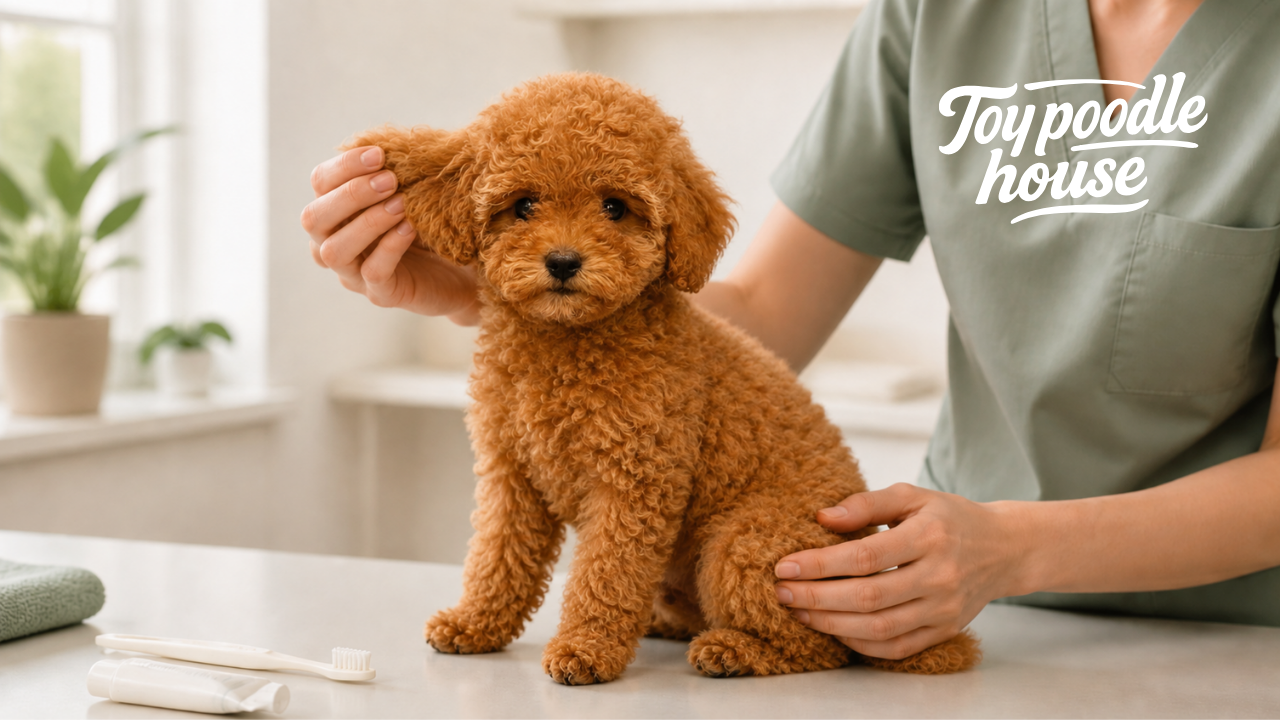
Poodle coats may have a low-shedding tendency, but if not brushed regularly, they can become matted. The areas behind the ears, under the legs, around the chest and between the limbs may tangle more easily.
Dental care
Dental problems may be more common in small dogs. Getting used to dental care from puppyhood is important.
Feeding
Very small puppies should not go too long between meals. Sensitivities such as low blood sugar should be monitored more carefully.
Home safety
In very small puppies described as Teacup, Tiny or Micro, risks such as falling, being stepped on, bumping into furniture or jumping from high places can be more serious.
For this reason, care should not be judged only by size. For many families, a Toy Poodle may be a more balanced and manageable option.
Do Toy, Teacup and Tiny Poodles Shed?
The Poodle breed is generally known for low shedding. Toy, Teacup and Tiny Poodles may also have a low-shedding tendency.
However, it is not accurate to say they never shed. Every dog has a natural hair renewal cycle. In Poodles, loose hairs may remain trapped in the curly coat. If the coat is not brushed regularly, tangles and mats can develop.
People with allergies often research Poodles. Still, no dog should be described as completely allergy-free. Allergies can be caused by hair, dander, saliva or environmental factors.
That is why anyone considering a Poodle should be ready for regular coat care.
Are Cm and Kg Enough When Choosing the Right Puppy?
No. Size and weight information are useful, but they are not enough on their own. Especially when terms like Teacup, Tiny or Micro are used, families should not focus only on size.
The following questions should always be asked:
Are the mother and father Poodles?
If one of the parents is Maltese, the puppy is a Maltipoo. A Maltipoo can be a lovely dog, but it is not a purebred Poodle.
Is pedigree or lineage information available?
For families looking for a purebred Poodle, pedigree or traceable lineage information is an important trust factor.
Have health checks been done?
Veterinary checks, vaccinations, parasite treatments and general health status should be explained clearly.
How many weeks old is the puppy?
A puppy should not be separated from its mother too early. Early separation can lead to both health and behavioural issues.
Is the breeder open to questions?
A reliable breeder does not introduce a puppy only with cute photos. Parent information, health, care, food and after-puppy support should be shared transparently.
Be Careful About Maltipoo and Poodle Confusion
One of the most common mistakes when researching Toy Poodle, Teacup and Tiny terms is confusing Maltipoo with Poodle.
A Maltipoo is a mixed dog created from a Maltese and Poodle pairing. If the mother is Maltese and the father is Poodle, or the reverse, the puppy is a Maltipoo. It may be curly-haired, small and very cute. But it is not a purebred Poodle.
Some uninformed or irresponsible sellers may present Maltipoo puppies as Poodles. Especially during puppyhood, the two appearances may be confused. Families may find it hard to tell the difference from photos alone.
That is why parent information should always be requested when a puppy is described as Teacup Poodle, Tiny Poodle or Micro Poodle. For families looking for a true Poodle, this is very important.
Which Poodle Type Is More Suitable for Whom?
Every family has a different lifestyle. That is why there is no single correct answer. However, a general evaluation can be made.
Who is a Toy Poodle suitable for?
Toy Poodles may be suitable for families who want a small but more balanced Poodle. They can be a good option for first-time dog owners, families with children, apartment dwellers and people who can provide regular care.
Who is a Teacup Poodle suitable for?
Teacup Poodles may be more suitable for people who understand the care needs of very small dogs, can create a safe indoor environment, recognise the delicate structure of the puppy and will not leave it alone for long hours.
Who is a Tiny Poodle suitable for?
Tiny Poodles may seem like a middle option for families who want a small dog but feel hesitant about an extremely tiny body structure. However, since Tiny is not an official standard, the puppy’s real growth details should be evaluated carefully.
Who should be careful about Micro Poodles?
Very tiny puppies introduced as Micro Poodles may not always be suitable for families with small children, very active households, frequent crowds or people caring for a dog for the first time. Extreme smallness requires careful handling and responsible care.
Choosing a Poodle Consciously with Toy Poodle House
At Toy Poodle House, we believe that the most important factor for families looking for a Poodle puppy is accurate information. Choosing a Poodle should not be based only on questions such as “Which colour?”, “How many kilograms will it stay?” or “Which one is the smallest?”
The right puppy should be chosen by evaluating true breed background, parent structure, health status, pedigree, temperament, family compatibility and care responsibilities together.
Toy Poodle, Teacup and Tiny may sound like different categories. But what truly matters for the family is whether the puppy is healthy, well-raised, truly has a Poodle background and fits the family’s lifestyle.
Families considering a Poodle should ask questions before making a decision, avoid rushing and not rely only on social media photos.
Conclusion: The Main Difference Between Toy, Teacup, Tiny and Micro Is Official Recognition and Reliable Information
Toy Poodle is one of the clearer and more recognised small-size categories of the Poodle breed. Teacup, Tiny and Micro are usually popular terms used to describe very small Poodle individuals.
That is why when you hear these words, you should focus not only on size, but also on the accuracy of the information. Real trust does not come from the phrase “it will stay tiny.” It comes from parent information, health checks, pedigree and a transparent breeder approach.
In terms of apartment life, Toy, Teacup and Tiny Poodles can all be suitable. However, the best choice is not determined only by centimetres and kilograms. Training, socialisation, grooming routine, family structure and the puppy’s temperament are far more important.
The term Micro Poodle should be evaluated carefully. Very small Poodle individuals can exist, but Micro Poodle should not be seen as a separate official breed class. The term is often used as marketing language.
If you are thinking about welcoming a Poodle into your home, focus not on finding the smallest puppy, but on choosing a healthy, well-informed, true Poodle puppy that fits your lifestyle.
With Toy Poodle House, you can receive detailed information about Toy Poodle, Teacup and Tiny Poodle puppies and make a conscious beginning in choosing the right puppy for your lifestyle.
Frequently Asked Questions
Are Toy Poodle and Teacup Poodle the same?
Teacup Poodle is often a popular term used for smaller individuals within the Toy Poodle category. Toy Poodle is a clearer and more recognised size classification.
Is Tiny Poodle an official breed?
Tiny Poodle is usually not an official breed classification. It is a flexible term used for small Poodle individuals.
Is Micro Poodle real?
Very small Poodle individuals can exist, but Micro Poodle is not usually recognised as a separate Poodle class in official standards. It is often used as a marketing term.
How many cm is a Toy Poodle?
A Toy Poodle is generally around 24–28 cm at shoulder height.
How many kg is a Toy Poodle?
A Toy Poodle is generally around 2–4 kg. However, weight may vary depending on genetics, nutrition and development.
How many cm is a Teacup Poodle?
Dogs described as Teacup Poodles are often around 18–24 cm. However, this is not an official or exact standard.
How many kg is a Teacup Poodle?
Teacup Poodles are often described around 1.5–3 kg. Exact weight guarantees are not responsible or reliable.
How many kg is a Tiny Poodle?
Tiny Poodles are often described around 2–3.5 kg. Since Tiny is not an official standard, these values may vary.
Is Toy Poodle or Teacup Poodle better for apartment life?
Both can adapt to apartment life. However, Toy Poodles may be a more practical option for many families because they can have a more balanced physical structure. Teacup Poodles are more delicate and require more careful handling.
Is the smallest Poodle always the best choice?
No. The smallest Poodle is not always the best choice. Health, temperament, parent information and family compatibility are more important.
Does a Teacup Poodle bark a lot?
A Teacup Poodle may bark, but barking is more related to training, socialisation and environmental triggers. Proper training can help reduce unnecessary barking.
Does a Tiny Poodle shed?
Poodles generally have a low-shedding tendency. However, regular brushing and professional grooming are still necessary.
Is buying a Micro Poodle risky?
Very small puppies described as Micro may be more delicate. Health, development, veterinary checks and breeder reliability should be evaluated carefully.
Are Teacup or Tiny Poodles suitable for families with children?
They can be suitable, but interaction with children should be supervised because very small dogs can be delicate. Rough play, dropping or squeezing may be risky.
Why is parent information important when buying a Poodle?
Parent information helps you understand the puppy’s true breed, possible adult size and lineage. If one parent is Maltese, the puppy is a Maltipoo, not a purebred Poodle.