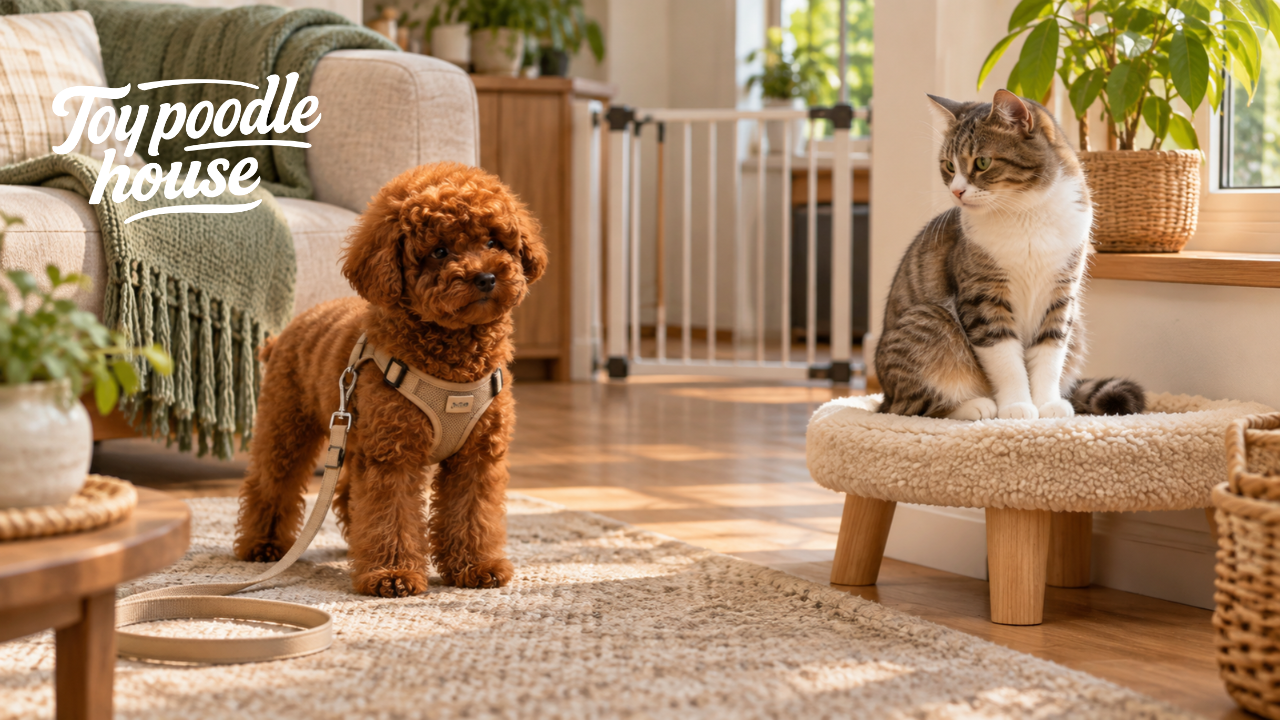
Yes — and the data is more optimistic than the folklore. In a study of 170 households, 66.5% of dogs and 65.5% of cats showed amicable behaviour toward the other species. But the authoritative introduction protocol gives no day-by-day timetable: progress depends on both animals being comfortable, not on the calendar. And there is a risk most guides miss in small breeds — cat scratch corneal lacerations are common in dogs.
“Cats and dogs don’t get along” is a cultural belief; the literature does not support it.
But “they get along” is not enough either. What determines the outcome is not the species — it is how the introduction is done, plus a few structural decisions.
First the data: do they actually get along?
The study
A study of dogs and cats sharing the same home combined a questionnaire with direct observation. Relationships were assessed in three categories: amicable, aggressive and indifferent.
| Result | Proportion |
|---|---|
| Dogs behaving amicably | 66.5% |
| Cats behaving amicably | 65.5% |
| Indifferent | About a quarter |
| Aggressive | The smallest group |
The study’s core finding: both species showed a similar ability to establish a relatively amicable relationship with the other.
🔴 And “indifferent” is not a failure
Alongside the amicable pairs, about a quarter were indifferent — paying each other no attention, but having no trouble either.
The protocol itself points the same way:
“The goal is for them to coexist, not to interact constantly.”
This matters for expectations. A pair that sleeps curled together looks good on social media — but that is not the measure of success. Two animals that leave each other in peace is also a successful outcome.
What helps
| Factor | Finding |
|---|---|
| Order of arrival | The cat arriving before the dog conduces to an amicable relationship |
| Age at first encounter | Up to 6 months in cats, up to 1 year in dogs favours amicability |
| Gender | Had little influence on the nature of the relationship |
The study recommends introducing them during the socialisation age.
A study in another country also found that introducing the cat to the dog at a younger age predicted greater amicability, as did the dog spending time indoors.
Note: These are statistical associations, not individual guarantees. A past decision — the dog having arrived first, say — does not determine the outcome; it only shifts the odds.
The staged introduction: four phases
The protocol below is taken from International Cat Care’s guidance.
🔴 First, a caution: there is no timetable
The protocol gives no numeric durations beyond “a few days” and “a few weeks”. That is deliberate:
“Do not proceed to later steps until each stage is comfortable for both pets.”
The “Day 1-3 do this, Day 5-7 do that” schedules circulating online do not come from this source. Progress is set by the animals’ responses, not the calendar.
Preparation
- A safe area for the resident pet. In the protocol’s words, “your existing pet needs to have a safe place which contains all their necessary resources.” For a cat this includes litter trays, scratching posts, perches and hiding places. Food and water are kept in this area.
- Physical separation. “A physical space should separate them,” such as a corridor or staircase blocked by baby gates or doors.
- Early set-up. New bedding, bowls and toys should be introduced a few weeks in advance.
- Keep the routine. The resident pet’s routine should stay as normal as possible, with extra time spent on activities they enjoy — play, puzzle feeders, extra walks.
- Escape routes. Provide multiple elevated perches or resting areas so the cat can get away. If the cat goes outdoors, keep that access without needing to pass the dog.
Phase 1: Scent swapping
The first step is not a face-to-face meeting but swapping each other’s scent.
- Place a small, single blanket or towel in the dog’s bed, let the dog sleep or rest on it for a few days, then move it to the cat’s area. Repeat in the opposite direction.
- ⚠️ Keep the scented item away from the cat’s valued resources. The protocol’s reason: so it does not cause anxiety and prevent the cat from accessing what it needs.
- Repeat over a few days, as long as both animals continue to appear relaxed about the other’s smell.
Phase 2: Investigating each other’s areas
Begin once both pets are calm and either interested in, or ignoring, the other’s scent.
- Let the cat explore the gap area outside its own space; then the dog investigates where the cat has been.
- As they become comfortable, walk the dog while the cat explores a dog-used area — or keep the cat occupied elsewhere with a puzzle feeder or game.
Phase 3: Visual contact
Start with limited visual contact. The protocol’s condition is explicit: both pets must be calm and able to retreat, with no chance of direct approach, being trapped, or having their retreat blocked.
- Use a baby gate mostly covered by a draped towel, while both pets are engaged in a calm activity.
- Keep the distance and the sessions short. Gradually uncover the gate and allow closer approach only if both stay relaxed.
- Teach the dog basic cues — “come”, “sit”, “lie down”, “look at me” — to help manage arousal.
- Gradually reduce rewards as they become used to each other.
Phase 4: Actual contact
- If possible, have two people so each can supervise one pet.
- Introductions must be directly supervised. If tension arises, use food or toy lures to create space.
- Keep initial sessions brief and positive, increasing time together gradually.
- Keep the dog on a harness and lead. Important detail: the lead should be loose and act as a precaution, not a restraint.
- When both are comfortable and relaxed, the lead can be dropped and allowed to trail.
Signs to slow down or stop
| Which animal | Sign |
|---|---|
| Dog | Vocalising, stiff body, raised hair, excitable movements, a tight lead |
| Cat | Signs of anxiety |
| Either | Fear, excitement, changes in body language or posture |
🔴 The single most usable criterion
“If the lead is tight, the situation is overwhelming for your dog.”
That gives you a concrete test that needs no interpretation: if the lead goes tight, the session ends.
If the cat shows anxiety, gently encourage it to retreat, hide or perch, and let it watch from a distance.
And the subtle point about timing
The protocol says to end sessions while both pets are still relaxed.
So the session should end before trouble appears, not because of it. That is a direct warning against the “it’s going well, let them stay a bit longer” instinct.
🔴 Two common recommendations the protocol rejects
1. “Put the cat in a carrier for the first meeting”
“A cat should never be placed in a crate for cat-dog introductions.”
The reason matches Phase 3’s condition: the cat must be able to retreat. A carrier removes that.
A crate may only be used for a dog that is crate-trained, relaxed in one and shows no fear of the cat. A harness and longline are suggested as alternatives.
2. “Grab one of them the moment it gets tense”
The protocol rejects this too: do not practice “crisis management”, meaning grabbing a pet when things look tense.
The recommended method instead is creating space with food or a toy.
3. And a reminder
Never punish the cat or dog for negative responses.
If introductions are struggling, or a good introduction breaks down, seek veterinary help; your veterinary team may recommend a qualified clinical animal behaviourist.
Feeding set-up: getting the reason right
Separate feeding is genuinely necessary — but the reason is usually stated wrongly.
🔴 An unexpected finding
In a study of cohabiting dogs and cats, the strongest predictor of amicability was where food was eaten — and the direction was this: the closer the eating place, the more amicable the pair.
That is the opposite of the assumption that separation improves the relationship.
⚠️ But causality is unclear
This is a correlation, and the causal direction could run the other way: animals that already get along may be the ones who can be fed closer together. Close feeding may not create harmony; harmony may make close feeding possible.
Separately, another study observed that cohabiting dogs and cats do eat in different places. The two findings sit in tension.
The sound reason: nutrition, not the relationship
| Situation | Problem |
|---|---|
| Dog eats cat food | Cat food is markedly higher in protein and fat than dog food. High dietary fat is described as a leading trigger for pancreatitis in dogs. It is also calorie-dense. |
| Cat eats dog food | Cats are obligate carnivores and cannot synthesise taurine, which dogs can. Taurine deficiency in cats can lead to heart and eye problems. |
Note: The sources for these mechanisms were commercial pages associated with pet-food products, so I have not carried over their percentage figures. The direction of the mechanism is consistent across sources, but for numbers your vet or your food’s label is more reliable.
🔴 And in a Toy Poodle the calorie question bites harder
Because a small dog’s daily calorie requirement is limited, even a small amount of calorie-dense cat food accounts for a large proportional share.
So a “snack” from the cat’s bowl can meaningfully disrupt the daily total in a small breed. That matters for weight monitoring as well.
The practical arrangement
The solution that satisfies both reasons is separate access, not separate rooms:
- Put the cat’s food up high. The cat can climb; a Toy Poodle cannot. The simplest and most effective fix.
- Separate bowls — the rooms need not be separate.
- Do not leave cat food out all day. A bowl sitting in the open is a constant temptation.
- Store food bags out of reach.
- Place the litter tray where the dog cannot reach it. The protocol counts the litter tray as part of the cat’s safe area.
- Supervise mealtimes, especially early on.
🔴 The risk small breeds face: eye injury
This section is missing from most introduction guides and may be the most important part for Toy Poodle owners.
The risk direction guides assume
Almost all dog-cat introduction content assumes a single risk: the dog harming the cat. That assumption is reasonable for large breeds.
But in a Toy Poodle, with a withers height of 24-28 cm, the picture differs. At that height the dog’s face sits at the cat’s paw level.
The finding in the literature
“Cat scratch injuries leading to corneal lacerations are common in dogs and cats.”
The next sentence matters too: every patient with scratch marks on the face, eyelids or third eyelid should be carefully assessed for corneal involvement.
Another source gives trauma as the most common cause of corneal ulcers and names a cat scratch directly as a cause of laceration. Cat scratches and ocular foreign bodies are listed among frequent reasons for consultation in veterinary ophthalmology.
Why it is serious
| Factor | Detail |
|---|---|
| The cornea is very thin | About one-half to one millimetre in the dog and cat |
| Infection risk | Cat claws may harbour harmful bacteria that can be introduced into the cornea and eye |
| Height | In a small breed the face is within paw reach |
Pasteurella multocida is named as the commonest infective organism associated with animal-inflicted wounds, with a substantial share of those wounds reported as cat scratches.
Practical consequences
- Do not run sessions at face level. Picking the dog up and holding it toward the cat puts its face exactly at paw height.
- Keep the cat’s claws maintained. A scratching post and regular claw checks are the simplest mitigation.
- Escape routes must work both ways. The protocol stresses the cat being able to flee; with a small dog, the dog needs to be able to leave too.
- If you see scratch marks on the face, have the eye checked separately. That is exactly what the sources advise.
- Treat any eye injury as an emergency. Sources state that any eye injury should be treated as an emergency with immediate veterinary attention. Diagnosis is made with fluorescein stain.
Note: The height-risk link in this section is an inference built from two verified pieces of information: the breed standard’s height range and the finding that cat scratch corneal injuries are common in dogs. I found no injury-frequency study specific to Toy Poodles.
Managing the early period
What should not change
- The resident pet’s routine. Meal times, walks, play should stay the same. The protocol stresses this.
- The integrity of the safe area. The cat’s space should be preserved as the introduction progresses.
- Physical separation. The barrier should not come down before the phases are complete.
The decision to leave them unsupervised
The protocol requires introductions to be directly supervised, with the lead dropped only when both are comfortable and relaxed.
So leaving them unsupervised is not a calendar item — it is a decision contingent on Phase 4 being consistently stable.
Going back a step is not failure
The protocol’s logic is not one-directional: if a stage has not become comfortable, you do not advance. The natural corollary is returning to the previous stage when needed.
And if a good relationship later breaks down, veterinary support is advised — so that is not an unexpected scenario either.
When to seek professional help
- If introductions are struggling or no progress is being made
- If a good relationship has broken down
- If either animal shows persistent signs of anxiety
- If there has been any injury — particularly around the eye
- If the cat begins avoiding its litter tray or food
As the source notes, your veterinary team may recommend a qualified clinical animal behaviourist.
Summary
A Toy Poodle and a cat can live together, and the data is optimistic. In a study of 170 households, 66.5% of dogs and 65.5% of cats behaved amicably; about a quarter were indifferent and the aggressive group was smallest. Both species showed a similar ability to establish a relatively amicable relationship with the other.
Indifference is not a failure. In the protocol’s own words, the goal is for them to coexist, not to interact constantly.
The introduction has four phases: scent swapping, investigating each other’s areas, limited visual contact behind a barrier, and supervised actual contact. But the protocol gives no day numbers — you do not advance until each stage is comfortable for both. The single most usable criterion: if the lead is tight, the situation is overwhelming for the dog and the session ends. And sessions should end while both are still relaxed.
Two common recommendations are explicitly rejected: a cat should never be placed in a crate for these introductions, because it must be able to retreat; and “crisis management” — grabbing a pet when things look tense — should not be practised. Create space with food or a toy instead.
Separate feeding is necessary, but for nutrition rather than the relationship. In one study the strongest predictor of amicability was where food was eaten, and closer eating places predicted greater amicability; since that is a correlation, causality could run the other way. The sound reason for separation is that cat food carries a pancreatitis risk for dogs through its high fat content, and that cats require taurine not reliably supplied by dog food. The practical fix is not separate rooms but putting the cat’s bowl beyond the dog’s reach.
And the risk small breeds face is eye injury. Cat scratch corneal lacerations are common in dogs; the cornea is about one-half to one millimetre thick and cat claws may harbour bacteria that can be introduced into the eye. In a dog 24-28 cm at the withers, the face sits at the cat’s paw level. If you see scratch marks on the face, have the eye checked, and treat eye injuries as emergencies.
How this process should run in your own home can be determined by considering your animals’ ages, order of arrival, existing behaviour and the physical layout of the house together. If the introduction struggles, consult your veterinary surgeon.
Frequently Asked Questions
Can a Toy Poodle and a cat live together?
Yes. In a study of 170 households, 66.5% of dogs and 65.5% of cats showed amicable behaviour toward the other species; about a quarter were indifferent and the aggressive group was smallest. The study notes both species show a similar ability to establish a relatively amicable relationship.
How long does the introduction take?
The protocol gives no numeric duration, only phrases such as “a few days” and “a few weeks”. The rule is that you do not proceed to later steps until each stage is comfortable for both pets. Progress is set by the animals’ responses, not the calendar.
What are the stages?
Four: scent swapping (swapping bedding), investigating each other’s areas, limited visual contact behind a barrier, and supervised actual contact. Beforehand a safe area containing all the resident pet’s resources, and a physical separation, must be set up.
Can I put the cat in a carrier for the introduction?
No. The protocol is explicit: a cat should never be placed in a crate for cat-dog introductions, because it must be able to retreat. A crate may only be used for a dog that is crate-trained, relaxed in one and shows no fear of the cat.
When should I end a session?
Sessions should end while both pets are still relaxed. The most concrete test is the lead: “If the lead is tight, the situation is overwhelming for your dog.” Vocalising, a stiff body, raised hair or excitable movements in the dog, and anxiety signs in the cat, also mean ending the session.
Should I grab one of them if it gets tense?
The protocol advises against it: do not practice “crisis management”, meaning grabbing a pet when things look tense. Create space with food or a toy instead. Neither animal should be punished for negative responses.
Do they need separate feeding areas?
Bowls should be separate, but the reason is nutrition rather than the relationship. In one study the strongest predictor of amicability was where food was eaten, with closer places predicting greater amicability — though that is a correlation. The sound reason is cat food’s pancreatitis risk for dogs and cats’ taurine requirement.
My dog eats the cat’s food — is that a problem?
Cat food is markedly higher in protein and fat than dog food, and high dietary fat is described as a leading trigger for pancreatitis in dogs. The most practical fix is placing the cat’s food beyond the dog’s reach and not leaving it out all day.
What if my cat eats dog food?
Cats are obligate carnivores and cannot synthesise taurine, which dogs can. Taurine deficiency in cats can lead to heart and eye problems, so the cat needs to eat its own food.
Is there a particular risk with small dogs?
Veterinary sources state that cat scratch injuries leading to corneal lacerations are common in dogs, and advise that every patient with scratch marks on the face, eyelids or third eyelid be assessed for corneal involvement. The cornea is about one-half to one millimetre thick in the dog, and cat claws may harbour bacteria that can be introduced into the eye.
I found scratch marks on the face — what should I do?
Sources advise careful assessment of the eye for corneal involvement, and state that any eye injury should be treated as an emergency with immediate veterinary attention. Diagnosis is made with fluorescein stain.
Is it better to get the cat or the dog first?
The study found that the cat arriving before the dog conduces to an amicable relationship. An early first encounter works the same way: up to 6 months in cats, up to 1 year in dogs. These are statistical associations, not individual guarantees.
Toy Poodle House
This content is for information only and does not replace examination by a veterinary surgeon. The rates and protocol steps cited come from published studies and organisational guidance and carry the limitations described in the text; findings from one study cannot be applied directly to every household. Please consult your veterinary surgeon about your animals’ behaviour, health and nutrition.